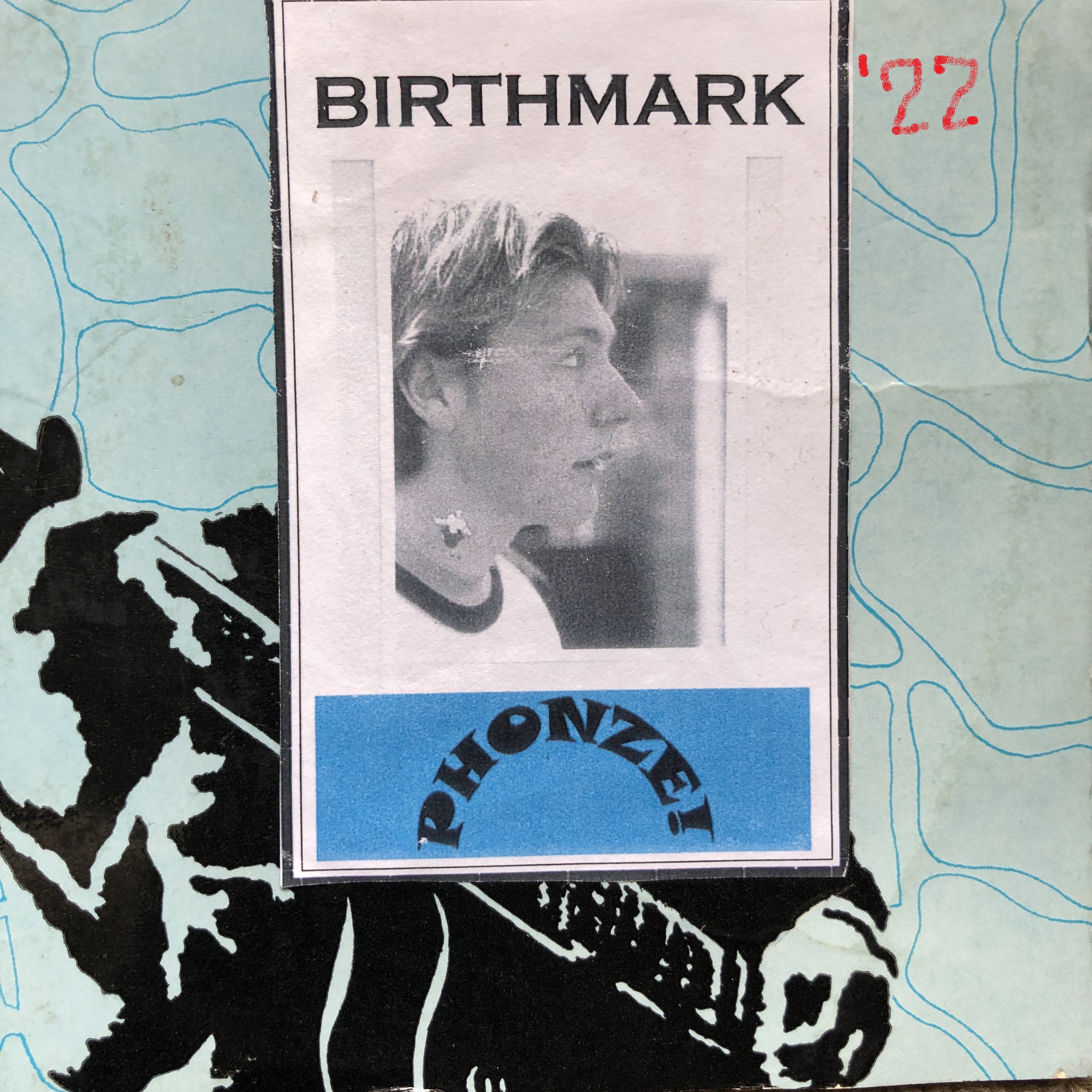
This is an album I made when I was eighteen and my nickname was Phonze! I’ve reimagined / remixed it with never released tracks and field recordings from the era.
Kurt Cobain, Shane Warne, stoners and skaters – girlfriends and god references – it’s a rough and tumble time capsule from the late 90s by a dude right into Beck and Radiohead exploring his own internal cosmos while honouring friends and Volkswagens with whatever means necessary. Brought to you by Sony Walkmans, Washburn guitars & Windows 95.
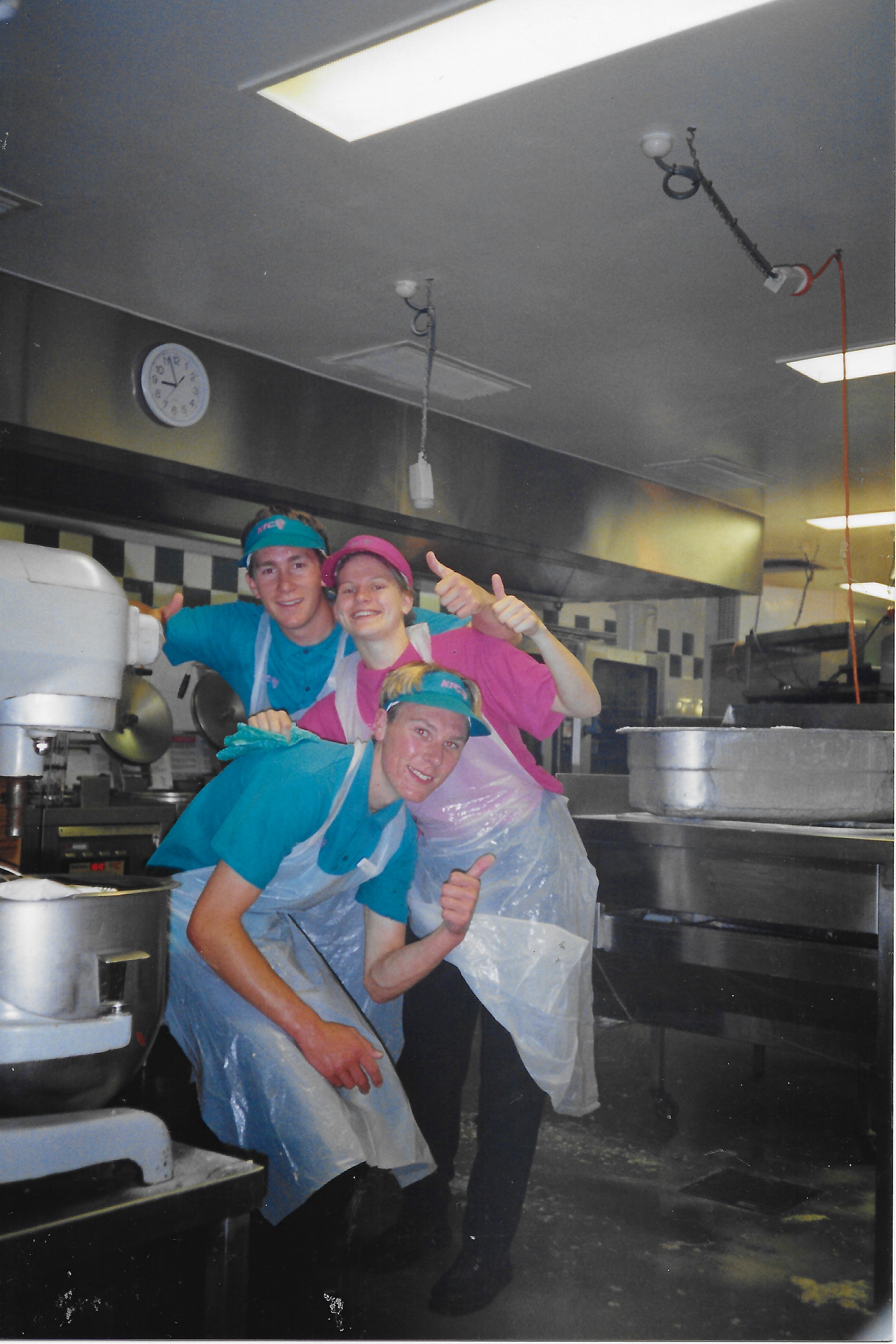
I first heard Aimee Mann’s I’m With Stupid in grade ten. The year was 1996, the town: Burnie; the shop: Soundwaves Record Bar. I had just started my first job as a death-cook for KFC, earning my own money – albeit $4.70 an hour. I think two hours of slave labour may have covered the heavily discounted double fluro price tags on this particular Cee-Dee. (One cannot underestimate the victory of actually finding something you liked on special, given that the average album price was $31.50 – today’s equivalent of paying for six months of Spotify to hear the same ten Pearl Jam songs, one of them skipping.)
I’d only just gotten my first CD player, characteristically late to the go-go-gadget party. While other kids were playing NBA Jam on Mega Drive I had a second-hand Amstrad green screen with Bombjack loading on tape. On our modest pensioner budget I was the Piping Hot polar fleece to my best friend Billy’s Billabong jacket. Musically enforcing my insider/outsider status; while other boys were ensconced in Gunners and Green Day – I was investing in techno cassingles like Here’s Johnny and/or discounted quirky songstresses from LA.
Another plot-point in the meeting of the Mann’s was that it was only the previous year that the North-West coast of Tasmania had started receiving Triple J. (Pair this with the fact Burnie got MacDonalds in 1993 and you can begin to appreciate the colossal injection of excitement for a teenager in the back-sticks. If Tassie had scored its own AFL team maybe I’d’ve gotten the cultural trifecta.) Triple J had upgraded my stereo to that of ham radio. Via its social subscription I was a two-way team member of my generation, doors opening to reveal Jane Gazzo pied-pipering us through a bandwidth banner as my imagination ran onto the hallowed mainland astroturf of alternative anthems by King Missile, Faith No More and Cake. Romantically, I was single, yet my relationship with this cool cosmos community was a fascinating defacto funfest.
(I rang Calamity Jane up a few times, determined to tell her how I was going to break the school’s 50m freestyle record, that my nickname was Phonze and could she please play ‘Bentley’s gonna sort you out.’)
Justin (FRONT) probably only giving the thumbs up to air off some recent third-degree burn from the chicken vats or industrial ovens
Meanwhile, ‘Long Shot’ by Aimee Mann was on medium rotation. I can confirm this as I have a tape of it being back announced by Michael Tunn (admonishing the previous caller for ringing up from their mobile phone while on a domestic flight. “They say you shouldn’t ever do that”). There’s also an interview with Gibby from Butthole Surfers and a segment where callers phone in with the flaws they’d spotted in Independence Day. The whole thing couldn’t be more 1996 if Fran Drescher was covering Lump by Presidents sponsored by Stussy.
If anyone asks you if there’s a newfound nostalgia for CDs – the format we long swore we’d never feel anything but bemused, obligated indifference towards once the shiny holographic promise of their ‘unbreakable’ marketing gave way to the snake-oil-charlatan reality of two years wear resulting in every second song getting a remix by Fatboy Slim – backed with the retina-stretching liability of deciphering liner notes in 7-pt; the answer is a resounding, mid-life, bellowed into a pillow: “yes.”
Yes, I played Long Shot, nay, BLARED IT in Surround Sound™ which my Sharp 3 CD changer afforded me, noting the spatial clarity compared to the head-under-the-bed compression of the Taped Off The Radio sound. Oh, to be sixteen again, plonked on the edge of your single mattress, pouring over the dynamic fridge magnet artwork and hazy artist portraits (all lyrics from I’m With Stupid are broken down into individual words and listed alphabetically)!
Hormones coursed through my gangly system like a technicolour forest of beauty and woe – crystallising my mood inside the lonesome wilderness of adolescence. Sparkly, intimate signals emanated from the padded black grills of the speaker box – entertainment as art absorbed in a halo of intelligence, curiosity and satisfaction. Beneath the alternative ambience of an after-school afternoon I afforded myself a double-value victory lap as my mechanical friend lurched the album around its carriage and back to the loading position. Helped by the odour of a Peter Jackson Super Mild smuggled out the window. I was revived and thriving, anything but alone in my teenage control room.
I was pleased to have a new inclusion in my modest CD collection, (comprising of RATM’s Evil Empire, Guru Josh’s Infinity, Spacehog’s Resident Alien, Butthole Surfer’s ‘Pepper’ single and Bruce Springsteen’s ‘Streets of Philadelphia’.) Aimee was my first musical girl. I knew nothing about her at all. I didn’t mind in the slightest. I was her prince silly, rescuing her from the discount bin in a small town that for multiple reasons hadn’t connected with her blend of Alternative pop-rock and whimsical lyrics about heartbreak and selfless relationships with damaged people – a theme it would take me another few years to fathom and two decades to perfect.
Justin’s very decked out room on residence at University of Canberra, 1999. You can make out the Sharp 3 CD changer and CD collection. I don’t know about you but I can also clock the timeless spines of Pearl Jam’s No Code, Beck’s Mellow Gold and George’s Holiday EP – err how did that get in there. Fair dues Holiday by George always has me tearing up. Is that tearing up, as in the healthy emotional response or tearing up as in tearing up my paper mache chain mail as I walk slowly backwards through IKEA? Much like what the chap says at the end of Radiohead’s Just, it’s best we never know.
In my first year at University in Canberra, my emotional world was blossoming outwards and inwards, not dissimilar to the flower motif depicted in Magnolia. Paul Thomas Anderson’s masterwork was a timely injection of Aimee Mann wonderment which sent the cultural value of I’m With Stupid climbing the rungs of my CD tower ahead of recent hotshots Garbage, Ben Folds Five and my failed experiment with Counting Crows. Released in 1999, Magnolia was the first real arthouse film to connect with my generation (that wasn’t Romeo & Juliet or Young Einstein.) Indeed, it was so good that it was actually hurting my new best friend Matt, literally depressed that he’d never make anything that good in his lifetime.
Aimee Mann’s song ‘Deathly’ single-handedly inspired the entire movie. If there’s a higher honour that has been paid a songwriter in recent times I’d be interested to hear about it. In the liner notes to the soundtrack Paul Thomas Anderson writes: “She is the great articulator of the biggest things we think about: ‘How can anyone love me?’ ‘Why the hell would anyone love me?’ and the old favourite ‘Why would I love anyone when all it means is torture?’”
It would make sense that a director would be drawn to Mann’s songs as they play like lyrical storyboards. There is a sense of narrative, of place. The language is visual and immediate. As PTA goes on to say “Aimee is a brilliant writer” and these are ‘story songs’ – which is perhaps a quality that could be dismissed as being a little, dare I say it, daggy. By that I mean to say that Aimee Mann’s compositions are disarmingly, wholesomely forthright when compared to contemporaries such as PJ Harvey or Tori Amos – fuelled by an edgier riot-grrl poetic abstraction.
That isn’t to say Aimee’s lyrics or compositions aren’t edgy. Any cabaret-esque over-spelling is under-written with smarm, juxtaposition and wit. S**t yes, Aimee Mann is witty! A rare quality in female artists that don’t toe-dip in pseudo-novelty such as Jill Sobule’s ‘I Kissed a Girl’ or Diana Anaid’s ‘I Go Off.’ Aimee’s an off-kilter, off-broadway eccentric, like Rufus Wainright or Suzanne Vega – or, more closely to my discographic heart; fellow LA misfit troubadour Eels.
Eels is also a bit ‘daggy’ in the indie-cool scheme of things, (Well, maybe I’m speaking out of school and drawing too much attention to my own internal crisis of confidence about what is relevant – but Pitchfork have slagged off most of his releases for being musically two-bit and lyrically hokey, which is code for ‘the kids aren’t comfortable with artists, (especially men) wearing their mentally ill minds on their sleeve and being intentionally vulnerable unless it’s done ‘authentically’ by a mentally unstable artist such as Daniel Johnston. Read: ‘If you’re going to be troubled, either strip it right back by singing your breakdown on a warbly acoustic, or, have the courtesy to dress naked lyrical honesty with full-tilt production al la Nine Inch Nails – self-pity is way too unpalatable to be presented as musically laid-back and self-aware as Eels does. Anyway, I disagress. (Disagreeing with my own digression.))
And, didn’t rage play Eels surprise new single only last week? (Oh good he’s going back to his Souljacker days.)
Pitchfork gave Aimee Mann’s complicated 2000 album (which she released independently after record labels were bamboozled by its lack of singles – who is she taking career advice from, Fiona Apple?) 9/10, so what would I know. Answer: heaps. Buy me a milo.
I’m told the case is now closed So I can come to my senses But when the question is posed I’ll have this meagre defence
Aimee’s songs are riddled with metaphor. Everything’s a set up. Love as a heist, relationships as a court case, boyfriend as a fallen superhero. There are twists on words. Plays on devices. Ducking and weaving and jabbing and hooking – Mann is the lyrical shadow boxer – floating like a butterfly tattoo and stinging like a worker bee.
As Paul Thomas Anderson pontificates: “She writes lines that are so simple and direct, you are convinced that you have either A) heard it before B) said it before, or even C) thought of it before (and just never wrote it down).”
I was hoping you’d know better / I was hoping but you’re an amateur
Songs are mostly about breakups. Odes to the calamity men who’ve wooed and screwed her every which way to dinnertime. I read that she had battled depression – there is a defiant dramatic tension that offsets any long stays on glib island.
I’m a superball / If you bounce me once I’ll ricochet / Around the room
So row, row, row your boat gently down the stream / I hope you drown and never come back
Anger marinated in eccentricity basted with irony. This recipe sets Mann apart from her contemporaries such as Sheryl Crow or Alanis “irony” Morissette. The lyrics are immediate, conversational and visual. Mouthfeel of the mind with heart aftertaste. They never drift or waft, rather announce and elucidate stakes of the highest order from a dulcet energy palate.
I’m so relentless / And you’re defenceless
Oh, and she rhymes her socks off. 🧦 Ms Mann’s like Dr Seuss meets Karen Carpenter.
You may wonder what the catch is / As we batten down the hatches
A double syllable rhyme worthy of Kim Carnes’ precocious / pro-blush.
But of course, the central thread that carries me from creation to memory and back is the voice. Aimee Mann owns my devotion through the gorgeous timbers of that velvet chamber.
And I don’t even know you / I don’t even know you anymore
She can hit the high-notes that fall you to the floor. She can glean the low-tone that floats your nose to the ozone. She whispers friendly and dangerous – truths disarmed in confident softness. Mann has approximately the best voice in history. Like none other in the canon. A god-standard Chrissie Hynde / Harry Nilsson masterclass in originality.
Hers is the vocal equivalent of a fresh pressed ruby velvet jacket. Sinking deep into a shady orange corduroy lounge, sipping an expensive bottle of French-Canadian merlot, reaching for a soft pack of Stuyvesants.
An Aimee Mann album feels like a special occasion. No, I don’t listen to her regularly. (Perhaps the richness of her voice means that one becomes fuller, sooner.)
But when I return I am always uplifted, reminded, surprised.
I’m With Stupid was one of the last holdouts on Spotify – outlasting Bill Callahan and Beyonce. (Mysterious, as the rest of her catalogue was there.) I lost my original CD and recently purchased a new second-hand copy, for approximately the same amount I paid in ’96 – in some satisfying twist of capitalist consistency. I was mesmerised by how much more alive the songs sounded. My ears used more muscles; heard extra instruments. As my friend Conrad once said “CDs sound better than streaming, even burnt ones. It’s something about the preamps in stereos.”
That said, in my current station; no longer the new sensation and far from the legacy veteran, it would not be in my best interests to bore you with rhetorical implorations to go out and buy your first CD in like, 15 years. All I’ll say ROCK FANS, is that there’s never been a better time to revisit this obscure slice of mid 90s Alternative and find a comforting voice in these abrasive times.
Dig?
I saw Aimee play live in 2009. I’d heard she was notoriously shy and awkward, especially about banter between songs. So much so that she’d hired a comedian to act as MC at her US concerts. Over-compensating for this by a long-shot – she proceeded to jabber nervously for up to ten minutes while taking photos of the audience before playing a single note. I am churlishly in awe of my idols when it becomes obvious they are consistent in their vulnerability.
At the end of the set she was taking requests. I was too insular to yell but I would have requested Long Shot. It is still one of my favourite songs of the nineties – conspicuously absent from any themed playlist.
Whatever.
A. Mann
And the award for best swearing in the opening line of an album:
You fucked it up / You jumped the gun / I swore you off / but You climbed back on.
Aimee Mann does this bright/melancholy, sweet hook, minor chord-twist dark pop thing that just fucking kills me. In a good way. It’s weirdly too rare in rock music. Any band that can do this as good as Aimee Mann, you’ll make me emotionally crumble and feel like life’s beauty is indisputable. Adam Gropman (via youtube)
Aimee Mann – I’m With Stupid (1995, Geffen)
Key tracks – Superball, Long Shot, Sugarcoated, Choice In The Matter.
Fun Fact: Aimee dipped her toe into acting by playing one of the German nihilists in The Big Lebowski. (Continuing her love affair with indie-darling directors).
Gigs: Aimee is touring Australia in 2021/22 with appropriate folk oddball Ben Lee!
Know something I don’t?
Keep it to yourself.
Justin’s CD inventory as catalogued by then girlfriend Tammy at their sharehouse ‘The TAJ’ (named after occupants Tammy, Adam and Justin) in Totterdell Street, Canberra, 2001.
A very 2001 looking, CD orientated sharehouse wall. Note the square metal CD holder display which I bought from a mail order catalogue in grade 12. BTW that is the Beatles poster I mention in Megan the Vegan. (CD display features Waikiki, Skunkhour, Supergrass, New Buffalo, Sleepy Jackson, Dandy Warhols, Divine Comedy, a fairly rare single from Radiohead’s Amnesiac and Starsailor!)
I guess you could say I have an intimate knowledge of indie releases from 2001 because of my job at the Uni magazine Curio. We were getting sent lots of review CDs and it kept me across awesome female singer-songwriter sneaker singles such as Airport ’99 by Phillippa Nihill of Underground Lovers and Like A Feather by Nikka Costa (one of Mark Ronson’s first hits as producer). Not to mention a promo copy of Aimee’s Bachelor No. 2 or, the Last Remains of the Dodo – now THAT’S how you title an album.
T H E E E N D E
READER SERVING SUGGESTION
Justin, hello, it’s reader here. I enjoyed your column about Aimee Mann.
Thanks!
You write in a very original, thoughtful manner. I remember my first CD by a female that I bought in my country town and there’s a great story about it. Shall I share it with you?
Please.
Where can I read more of your writing like this, in this style or whatever.
Oh, there’s the “MUSIC” tab under ‘Columns’ which has a few similar proto-pretentious fine-arts deep-drives. Or just keep scrolling down the page as I’ve recently gone on about the film Love Serenade and my love of synthesisers.
Okay, thanks Justin, I really appreciate you sharing your writing here on your website.
Thanks! I appreciate the feedback, even though there is no comments field because WWPD (what would Pitchfork do)?
After my Pop passed away last year, I found myself wearing his clothes. This was nothing new. Back in 1998 when I first discovered op-shopping, I realised I had an exclusive treasure trove right under my nose. During a regular weekend jaunt to Nan & Pop’s I asked politely if I could inspect their wardrobe, and with the excitement of one passing through the ‘Staff Only’ door at Salvos, initiated a gangly, late-teens version of dress ups.
Whenever a fellow secondhand droog complimented me on my retro jacket, it was with great pride that I said it was my Pop’s. Adorned in a full set of his clothes, I strolled through Melbourne one brisk winter morning like a soldier of nostalgia trying to blend in with the past. Top: safari jacket, dark green, pure wool from New Zealand. Bottom: dark green, flared suit trousers. Shirt: pale lime green Pelaco brand. Singlet: Bonds, athletic. Socks: knee-length bus driver style. Underpants: yes, underpants. They were a pair of cheap generic boxers that Nan had bought but he’d never worn. The clothes made me feel safe, purposeful, loved. He was a quiet man who never said “I love you.” But what an impoverished upbringing and the Second World War had economised in his language, he made up for with a generous smile and patient ear.
There are days when the loneliness really hits me and find myself scuttling through the sand layers of my mind to find my fondest memories of him. I’m six, it’s a breezy, summer’s day and we’re walking along the beach. This was our walk. These were our times. We’d do it regularly. Pop would plod along at a steady pace, watching me sprint ahead and poke around in the sand. I’d run back and find his large, warm hand. The beach was an endless runway of delight where my adventures could take off. The clear salt waves nipped at my senses, while the vibrations of his voice ran through me as I rode high on his shoulders. Constant shiftwork had not allowed him to have this kind of time with his own children. It must have been such a joy.
Today I wear his clothes like a hug. When I first got them they still smelt like the cool linen stillness of his cupboard. It’s a scent I wanted to bury my face into; to curl up like a cat and fall asleep in. I was transported to a time before custom and expectation, when a simple woolen jumper held me safe. Now they’ve been through the wash a few times, but the cloth still connects with my blood. I am reminded of the love for my family, and this man who would be a father figure to me. Wearing his clothes makes me feel strangely complete. Like a traveller returning to the place they were born.
The truth is I’ve been wearing the clothes of the deceased for years. Not everyone is comfortable with this. There are those who scoff and hang cruelly on the edge of secondhand shops, dabbling their toe in the dust-ridden air, daring each other to go in. What twisted expression could I evoke with tales of my grandfather’s undergarments keeping me snug at night? I wouldn’t want them to understand.
My friend in Hobart said his father had just passed away and he too had taken to wearing his underwear and socks. He didn’t offer an explanation. He didn’t need to. In this global shop-front/techno-paddock world, sometimes we need to walk like kingdoms and wear our memories like flags.
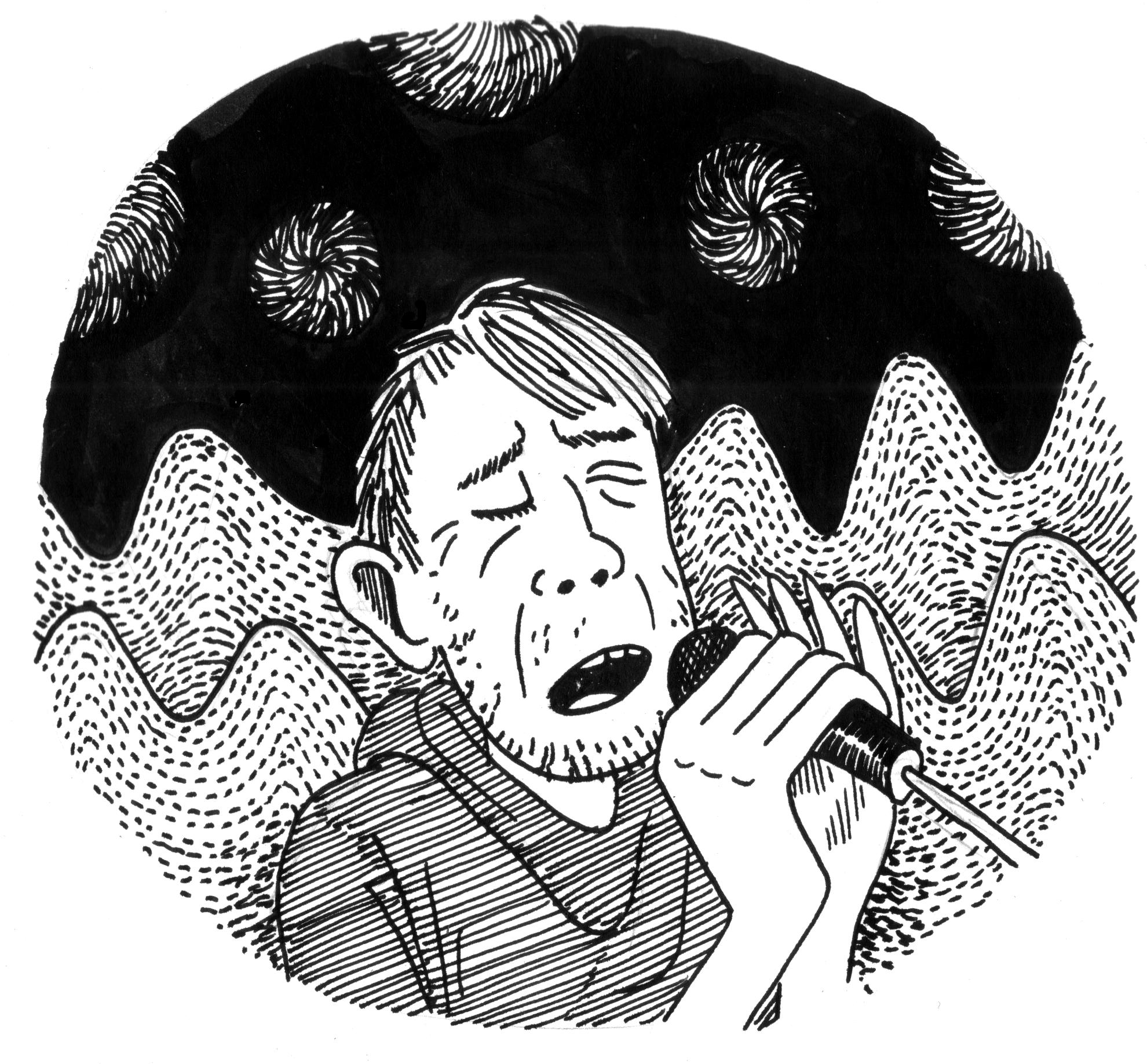
The first cut is the deepest, and Radiohead’s Creep cut me in a big way. It was one of my first experiences of a rock band. I watched the film clip, mesmerised. The picked tremolo notes rang like a macabre musical box while the chorus cut through like a chainsaw. Who were these pale, effeminate men, slinging and scrunching their way through such a pretty tune? In the stage lights Thom Yorke looked alien. His face contorted in ecstasy and angst. Johnny Greenwood hid behind a wall of noise and fringe, revving his guitar like a lawnmower.
When asked about Creep in 1993, Yorke said, “I have a real problem being a man in the ’90s. Any man with any sensitivity or conscience toward the opposite sex would have a problem. To actually assert yourself in a masculine way without looking like you’re in a hard-rock band is a very difficult thing to do.”
Until then my poster boy for masculinity had been Lenny Kravitz, strutting his way through 70’s pastiche glam. Radiohead sat brooding in the corner of the charts party, showing how vulnerable rock could be. No more Party Uncle, this was Arty Dad sitting me down with a bag of minor chords and telling me the birds and bees of sexual emotions. My world was ready for the juxtaposition of self-loathing in popular song. John Lennon had sung I’m a loser, Henry Rollins I’m a liar and Dennis Leary I’m an Asshole but they were all delivered behind a front-line of irony. Thom Yorke was compellingly exposed. An anti-hero who didn’t ask you to believe in him. His karaoke-slaying falsetto and crooked-eye weirdness gave the impression of a long suffering schoolboy – a life spent reading in shady rooms, sticky with illness, never getting enough sun.
Creep was a song for a generation of boys lusting clumsily through the schoolyard of life. Yorke said: “It is one of the things I’m always trying: To assert a sexual persona and on the other hand trying desperately to negate it.” Repressed sexuality was something that would define my school years. On one hand I was trying to be nice and Christian, and on the other I was feverish with hormones, keeping a diary of which girls had looked at me that day and taking too many baths.
Drying up in conversation, you will be the one who cannot talk
All your insides fall to pieces, you just sit there wishing you could still make love
When I first heard this lyric I nearly cried with embarrassment. Any closer to the bone and I’d have a heart attack. When asked what inspired the songs on The Bends Thom Yorke replied “Impotence.” While he was probably referring to a more general feeling of powerlessness, I clung to the word like a life raft. I’d just spent a bleak Australia Day home alone not having sex with my girlfriend. My Oasis poster wasn’t helping. I could hear Noel and Liam dissing me, back with another one of their cock-rocking bleats. The Bends was audio balm – gentle medicine for my collapsed soul. Someone felt as sad as I did.
* * *
Kid A is my favourite Radiohead album, and in my opinion the last musical masterpiece. I remember bringing it home in second year Uni – my flatmate Adam and I turned off all the lights and lay on the lounge-room floor, swimming in sound. A few days later I was home by myself listening to the vocal crescendo of ‘Motion Picture Soundtrack.’ The CD skipped, causing Thom Yorke to hold the note indefinitely. Perfectly.
I’ll see you in the next liiiiiiiiiiiiiiiiiiiiiiiiiiiiiiiiiiiiiiiiiii…
I stared at the stereo in disbelief. It was bizarre and beautiful. A moment created just for me.
I remember Triple J’s Morning Show first playing my favourite track The National Anthem.
“It’s a long way from Creep isn’t it?” Said Francis Leach, with a sense of respect and trepidation, as if he still wasn’t sure which camp he belonged to. The disc dropped like a buzz saw, cleaving the world in two like great art. There was no sort-of liking Kid A, you were either saluting their inventiveness or mourning the lack of guitar songs. On writing the album Thom Yorke said he’d “completely had it with melody” and just wanted rhythm. He liked the idea of his voice being used an instrument rather than having a leading role.
The National Anthem is menace and finesse. Ominous and tough. Haunted and defiant. Entrancingly simple and deftly layered. It’s strut-prog drone-funk that flutters the subconscious and churns the stomach like butter.
Death jazz.
At 0:01 we hear an electro glitch, the delay of a switch – the mother ship of malevolence warms her valves. The bass lays cables of dark fuzz, the stunningly primitive three note loop lurking down the scale. (Yorke wrote the riff when he was 16). The cymbal smashes in like white sun on ice, leading a galloping drum pattern, swinging and bowling like an eight legged kinetic road horse.
At 0:22 the cymbal is robbed on the first bar – delectable editing from Nigel Godrich. The percussion jumps a ravine before picking up on the fifth. It’s dropouts like these that add funk to the fury. At 0:54 there’s lashings of ride cymbal smacking. Beneath it synth lasers spiral and howl like remote space stations shooting digital comets into the lunar abyss. Snippets of ghostly brass warp and warble. The song paces back and forth like a horseman.
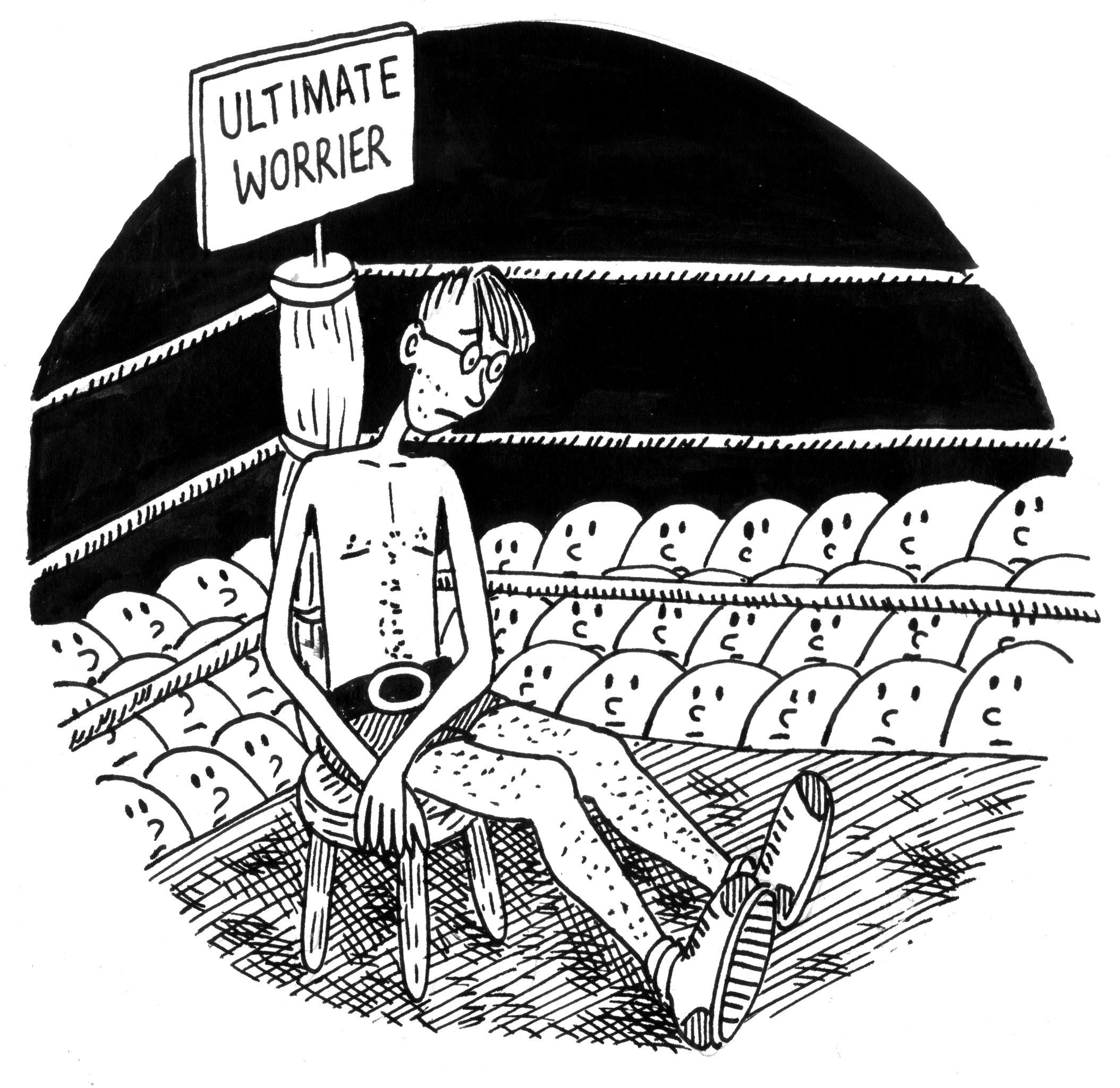
When I listen to The National Anthem on public transport, I feel tough and fucked up at the same time. It’s the soundtrack for my loner superiority. If I were a professional wrestler it would be my themesong. I’d be called The Ultimate Worrier. My signature move would be The Schitz. I’d wriggle my limbs uncontrollably, psyching out my opponent.
Synths and cymbals stop. Vocal begins.
Everyone (bassbassbassbass-bassbassbass)
Everyone around here (kickety-snarity-kickety-snarity)
Everyone is so (smasssshhhhhhhhhhh) near
and so alone.
Thom Yorke’s voice has a metallic echo on it – half robot / half ghost. We are treated to a Theremin trail and the wack-tableaux of a child’s la la la. It’s an eerie nod to the patronising monotony of city living. The lobotomy of misspent intelligence. The kid in the back seat of the car, young and free, poking his tongue out as your blood boils.
Everyone / Everyone is so near / Everyone is ? fear / It’s all a lie / It’s all a lie.
There is no song more audacious. From it’s very title it runs a dark claw beneath the stiff upper lip of modern day Britannia. It’s the Kraut-rock opera for a traffic jam, a pummelling hymn for those encased in the metal coffin of capitalism. The spiritually constipated. The Ok Commuters. It’s an unromanticised, unapologetic, undiluted musical army barnstorming the restrained recesses of popular music and turning over tables like Jesus in a temple. Charlatans! Hypocrites! It cries. Your pomposity and saccharinity has stagnated. Where’s the show don’t tell?
At 2:38 horns become weapons. Radiohead show us what blood and guts sounds like. The microscopic screech of a life half-lived. Amplified. Contorted. Mutated beyond human shape. Alarm wails for the professionally world-weary. Rails buckle under artificial heat. Trains of thought rattle and tip. Dreams lay crushed in stagnant ambulances. Unapproachable wounds. The blunt reality of our unpublishable selves.
Nick Drake sang I am the parasite of this town, while Trent Reznor wrote You could have it all / my empire of dirt. REM’s Everybody Hurts film clip features human traffic stepping out of their cars and moving on. The closing three minutes of The National Anthem is a furnace of sonic distress. A brassy black hole where sentiments melt down to their base elements and erupt with backlogged, unresolved emotion.
It’s all a lie.
It’s all a lie.
At 3:46 there is respite. The song stops to breathe, like a crazed man tired from self-rumpus. Voice and trumpet are one. Blood flows. Traffic moves. At 4:03 a string is tightened. Nerves pull taut. At 4:08, a death scene. A lone trumpet speeds out of control. A poisoned wind-nymph spiralling through death throes. It’s musically graphic. The sound paints a thousand pictures.
The horns are wonderfully ugly, like the creatures in Pan’s Labyrinth, there is a labour of love in their ghoulish design. They bleat like sheep, wail like children, harrumph like Roald Dahl characters, zigzag like autistic etch-a-sketch, compete like sperm, jostle like chimps and clog up the void like orchestral off-cuts. As with an audio Jackson Pollock, strips of colour have been thrown on the canvas with such precision of vision that the final mix, as messy as sin, convinces the audience it is as much and as little as it needs to be.
It’s busy.
Like life.
By 5:00 the song’s been going for dog days. No more ABAB. This is alphabet soup. I want to cry. Sympathy for the demons. The subconscious hits and conscious misses. A booklet of bruises. At 5:15 the song runs out of steam. In the studio Johnny Greenwood orders the players to choose a random note, waving his stick like a wizard. “Just blow. Just blow, just blow, just blow.” There are two such ghastly blasts. The sword is driven into the dragon. Swirls. A chilling vocal sample. Man caught in limbo. Falling awake.
Delay is sped up and sped down – the Godrich signature.
Finally, there is end.
The National Anthem is compelling, disturbing, offensive and exciting. An anthem that hammers the dimensions. Each play, a moment in history. A personal revolution.
* * *
To off-set their overblown presence, Radiohead are often met with a teenage aloofness. “I kind of stopped bothering with them.” They dwell in their own chamber – off the mainstream radar but alternatively popular beyond scale. I like to think of them as The Beatles of my time. Too often they are the round peg for my holy soul.
First published Mess+Noise 2011. Illustrations by Leigh Rigozzi.
Welcome to the new blog. (A blog is not a website, I’m learning – you can’t just write a post and have it send to the page you’d like. It’s like driving a manual.) I’m taking my writing more seriously this year – watch out. My new book (Funemployed) will appear in June! I’ll endeavour to add to this each week and not be sabotaged by American spell-checks. (“I put a spell on you…”)




 f u z z y ⚡ l o g i c