Draw a line in the cocaine. This is the moment I exit popular / youth culture. The word is FEELING. Having emotions isn’t funky fresh. I mean, the word vegetables is shortened to veggies, but this is like that process on speed and adrenaline. Don’t get me started on the ISO trend of lockdown. It’s disrespectful to the mental illness community who were experiencing stone cold isolation before and after Covid. Just use normal words around the fundamentals of human psychology so we don’t run the risk of oversimplifying or nullifying them. Feelings aren’t f^%&^g cute, at least not from where I’m cradling them.
DOGGOES / WOOFOS / FUR BABIES
They’re called dogs. We are grown-ups. It’s folksy, it’s hokey, it’s overly familiar and infantilised. It sends a weird message to non-dog worshippers, especially on dating apps. I’m looking at you Dimity, 39.
INTENT
Drinking game: watch the cricket commentary and have a bite of schnapps when Ricky Ponting drops the ‘I bomb.’ You will be morose and plastered by the time Steve Smith has been dismissed for playing some bizarre shot.
LEARNINGS
The language equivalent of a gargoyle who has risen up from the earth to destroy all of mankind. The worst corporate mutation to infect society since the on-sell / thru-connect era of the mid 2000s. Anyone using LEARNINGS should be placed in a vault for retooling. (That said, Max Gawn dropped it on The Front Bar last week and I don’t really fancy taking him anywhere, so free pass for Max if he corners me in a dark alley.)
P.S. The word is LESSONS by the way. P.P.S. I will accept Learnalilgivinanlovin by Gotye.
COSTINGS
See: LEARNINGS. Sounds like it was made up by a small child.
PRESSURE
The AFL would do well to relieve its own ‘commentary pressure’ by pulling the pin and taking a chill pill on the P pill for a pre-set period. If the word pressure was a commodity it would be extracted from a mine in South America by small children, as it has been well over-mined. It undermines what would be an otherwise quite-boring, low scoring modern game.
STRESS
Pressure is to sports commentary what Stress is to TV journalists. Rent stress, food stress, how about syntax stress? Ever considered that hearing the word STRESS every five minutes is, I don’t know … stressful? Lord, get a thesaurus people. Housing concern, food tumult, climate botheration? Those ‘S’s’ are stirring my hypervigilance. Repeating the same word is just bad writing, he said non-pretentiously.
CHIPPIES
See: DOGGOS. Never say this around me or at any other time, unless you still enjoy single digit birthdays. Exception: the musician Wilding because he is English and lovable and I fancy my chances encountering him in a Melbourne laneway.
SUPER
The biggest weed word since ‘like.’ People are ‘super something’ instead of the 36 other choices. Super excited? Super grateful? Why not try uber, ultra, unbelievably or bloody turbo. I am like, super-vulnerable to the innate trashiness of this extremely popular adverb.
Super used to be a point of derision. Remember the impression you’d do of a perky Canadian saying ‘that sounds super!’ Super was going the way of Awesome which raised the ire of wordsmiths for conjuring the tone of an evangelised Christian camp.
Adults inevitably appropriate the language patterns of youth subcultures as society is still beholden to its over valuing of youth. Does social media speed the process up? Or, are you actually young. It’s a pity as Iga Świątek is one of my favourite tennis players and every time she is interviewed she pollutes her unforced error count with a barrage of S***r prefixes.
Am I reading too much into this? Should I get a doggo intent on iso and enjoy some learnings pressure?
Sounds like feels stress.
WORDS THAT SHOULD MAKE A COMEBACK AND BE USED IN A SENTENCE BY A COMMENTATOR IMMEDIATELY
Skedaddle
Shemozzle
Kerfuffle
Notwithstanding (a supergroup!)
Curtail
Mesmerising
Crestfallen
Sun-dried tomato (no wait, this is my sandwich order.)
August is poetry month and Red Room Poetry have selected me as one of 30 poets who will be featured each day. I’ll be performing some of my poems as part of the stanza extravaganza August 3 at MONA, 2-3pm. It’s hosted by Daniel J Townsend, who is a good egg.
My poem 13 Ways To Drink Chocolate Milk will also be published in the Guardian at some point during August. Follow my online interactive sharing squares to catch my piece as it drops. More info HERE.
Love Serenade is a quirky Australian comedy from 1996 starring Miranda Otto.
It comes from a fine vintage of Australian quirky comedies featuring Muriel’s Wedding and The Castle but made up also of lesser knowns such as Jane Campion’s Sweetie.
This was a time when Australian comedies were oddball, understated and devastatingly rural. It’s a flavour that has not been seen for twenty years now, when Baz Luhrmann brought in the ‘more is less’ acting bombastics and writer/directors opted to ‘shirk the quirk,’ investing in bleak, gritty dramas and high-gloss middle-class comedies. Perhaps The Castle capped the golden age of the quirky Australian comedy – with a nod to Two Hands rounding out the decade in ‘99.
A last celluloid gasp of an Australia on film that hadn’t quite been nebulised by an American cultural assimilation powered by the globalisation of social media and the echo chamber of the reality-tv decade.
Sound complicated? Well, by contrast Love Serenade is a simple film. It’s about two deadbeat sisters who work themselves into a craze when the star of the Brisbane radio scene Ken Sherry rolls into town and moves in next door.
This film may receive the all-time lowest score in the The Bechdel Test (aside from Mary Magdelene) as the entire lives of the two girls revolve around a man. This is fine and I really do try hard not to reverse engineer films by today’s political standards. Rather, I get a hotshot of bemusement from nineties films referencing themselves as the ‘here and now.’ (For example, Cameron Crowe’s Singles from ‘92 was unexpectedly humorous as the hip twenty-something dude stayed at home hanging on a very important fax.)
In our case, Ken Sherry is disappointed that the local radio station of Sunray hasn’t evolved to CD technology. Instead, he must play his records and wax philosophical into the microphone (allowing the movie to date in a more timeless, graceful, needle-in-the-groove manner) in one of cinemas most relentless presentations of ‘mansplaining’ (which along with the Bechdel Test atrocities might make some millennial viewers anxious and perhaps should come with a label warning) which would probably be worthy of some kind of academic stoush if the film weren’t written and directed by a woman, Shirley Barrett.
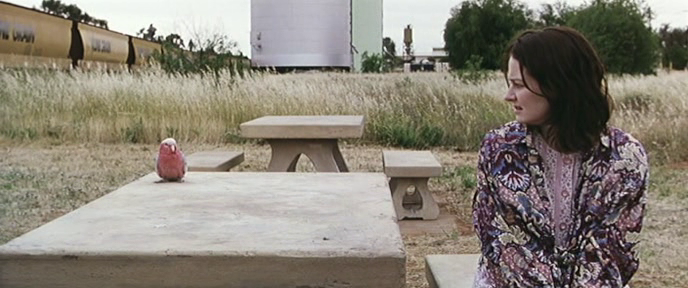
The highlight of this film is Miranda Otto. She is very funny. For someone who might be known as the shieldmaiden from Lord of the Rings or a steadfast character in a low budget indie – it’s something of a revelation that she plays the all-slouching, all-scowling, amateur seductress and fish enthusiast Dimity Hurley. Some of the best scenes come early, in which Dimity is the embodiment of teen angst and low self-esteem, trying to carry on a conversation with Ken Sherry. It’s as if she’s so riddled with disappointment at her own answers that she can’t convince her face to arrange itself in any position other than forlorn contempt.
There is something fiendishly anti gender-type and bountifully funny about a severely disappointed looking girl delivering lines matter-of-factly – as if absolutely everything in the world is a bother to her. (To quote Joyce from American Splendour “why does everything in my life have to be such a complicated disaster?”) There is something so familiar and believable about Dimity. She is so devastatingly…plain. Yet, also in possession of a defiant, non-conformist attitude that surely deserves some cultural positioning alongside the ‘riot-grrl’ movement of the 90s. Perhaps certain elements of the Australian ‘calling bullshit’ country attitude crosses-over with the aforementioned punk-grunge aesthetics of the big cities.
Dimity is the embodiment of the sociologically suppressed endearingly oddball ‘misfit girl’ – an archetype that isn’t exactly over-represented in TV and cinema. I think of Tora Birch in Ghost World, but she is positively glamorous compared to the washed out polar-fleece suburban world that Dimity dwells within. (And say, Mattie in True Grit is brash as a way to overcompensate for her non-lady likeness – as if the writer is thinking we’d better give this girl some redeemable qualities or the audience will never embrace her, similar to Daria and Darlene from Roseanne.)
People find you a bit odd. That’s all. It’s only because they don’t know you like I know you admittedly but you just have that effect on people. Well, maybe if they get to know me like you know me they won’t think I’m so odd. No actually I think you’re odd too.
Dimity in contrast is a strange and daring understatement of quirkiness and low-stature. To find a closer example one would do well to stick closer to home – and enjoy the whimsically understated performance of Karen Colston in Sweetie (or perhaps Mary from Mary & Max?) and Magda Szubanski’s immortal Sharon Strzelecki from Kath & Kim. The only American attempt that comes to mind is Martha from the sitcom Baskets (played by comedian Martha Kelly) – a veritable masterclass in deadpan comedy.
Love Serenade’s underhanded approach means that by the time Dimity is throwing herself at Ken Sherry, the sight of her teeth bared in a dorky smile is positively confronting. A scene which could have been positioned as glib or throwaway is given considerable gravitas as the actor and director demonstrate a commitment to the idea, Otto flipping the tone from bumbling comedy to surreal arthouse in what must be one of cinemas most idiosyncratic depictions of female nudity.
Films like this are a time warp for Australian culture. Not to say that sleepy old country towns don’t still exist and resemble the fictional Sunray (located on the Murray River), but more to the point of how we used to represent ourselves on screen. Muriel, Priscilla and The Castle spoke to an affinity with our innate sense of dagginess. Rather than pump itself up to be seen as America’s cool little brother, we used to double down on how isolated and underdog* we were (perhaps a final shudder of low self-esteem from being Britain’s punching bag?)
* the underdag, if you will – screw you auto-correct, I had to type that three times.
Think of The Late Show’s ABC parody Still Number Four. A quarter of a century sounds like a long time for a cultural shift, especially when you’ve had twenty years of the world wide web. In the 90s we had ‘battler pride’ infused in the cultural lifeblood of our creatives – not just something cynical politicians pulled out to seem relatable. Australia celebrated being the little guy and more importantly (and accurately) the outsider. It feels a world away from the high-camp high-gloss meme-toting in-your-face brashness of the kinds of millennial comedies that seem to pop up and manifested itself in Working Dogs’ 2012 mainstream comedy ‘Any Questions For Ben?’ in which the lead character was a marketing guru.
I’ve often argued that dagginess, in its purest form, no longer exists. The internet has simply made us too self-aware. It’s a ‘genie out of the bottle’ level of consciousness that can’t be rolled back. Films from the 90s, like music videos from the 80s (unhinged American dancing makes me uncomfortable), confirm this theory – their authenticity and blind confidence making them nostalgia darlings for future generations finding their footing amidst a cultural melting pot of cold cuts and fragmented references.
Love Serenade has a clear and present soundtrack. (You can find it on Spotify. I’m a very big fan of Rock Your Baby.) 1996 was a time when Barry White was played. The 70s tribute was a characteristically 90s thing to do, which now feels like a double throwback as I can’t think of the last time I heard Barry White used to earnestly represent something sexy. It’s gone the way of The Stripper, Wipeout, theme from Psycho and other scene-setting loony tunes I first heard played on Hey Hey It’s Saturday. (I mean, did Paul Thomas Anderson use Barry White in 1998s Boogie Nights? No. That was probably first on his list of last songs to use.)
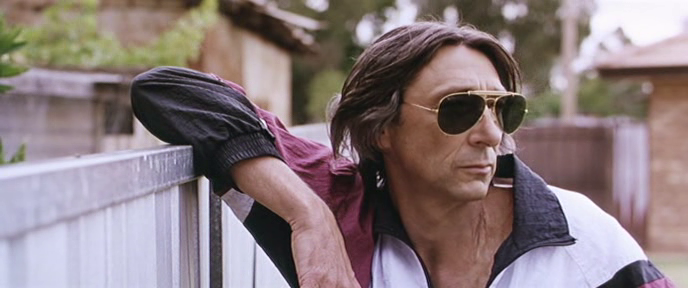
Ken Sherry is WAY older than the girls, which gives the film a layer of menace and dramatic tension that I’m sure wasn’t around even ten years ago. He’s positively sleazy and reprehensible, in a way that was a lot easier to doze off in front of in 2006 (even right next to your feminist partner), but now feels like an invisible finger in the room poking you regularly. Modern day real-time comedic-value depreciation aside – it’s a mesmerisingly even performance by George Shevtsov who I haven’t seen since. (Incidentally only the day before I watched the Seinfeld episode in which an actor (Larry Hankin) plays ‘Tom Pepper’ playing Kramer in the meta-fictional version of Jerry’s sitcom Jerry (you following me?) – the similarities between the two actors felt oddly familiar).
They both look like they could be half-fish half-man.
This theme is explored in a delightfully unexpected way as Love Serenade deploys one of the rarest of all ingredients in Australian film – surrealism.
A linguist would note the integrity of the 1980s Australian accent as archived in films like Muriel’s Wedding. It’s a commodity that is rapidly diminishing as the Americanisation of our dialect continues unabated. In fact, it’s not just the absence of mobile phones that makes films like this a surreal dream of an experience, but also the omission of the word ‘like’ and inclusions of dinki-di Australianisms like…casserole.
Miranda Otto is the star of this show. Right up to the end, goofily grinning in the background as Ken Sherry delves into one of his exterior monologues atop the silo. I found myself laughing out loud at the performer who has no lines in the actual scene. In fact, so much of Otto’s comedy is conveyed through the silent mannerisms of Dimity, that it feels like requisite viewing to go back and appreciate the subtleties of her face winding its way around from content to troubled and back again as she waits at a park bench – or the good twenty seconds spent tying and untying her t-shirt around her waist as she waits for her sister.
Much like Otto’s performance, Love Serenade is a film that looks deceptively simple to make on the surface, but sails an understated and consistent line that requires great craft and forethought. Watching the director / actor pair up again for 2010s South Solitary, one can appreciate that cracking a frequency of laconic lowkey charm (and making it gripping and refreshing and amusing) is a lightning in a beer bottle exercise. I wish this film were more available as it might restore some battered pride in this country’s ability to produce comedies that are not only funny but unique and original – it seems that baton got passed over to New Zealand and Taika Waititi in the late 2000s.
NOTE: There is a sex scene featuring a less than animated Dimity underneath a workmanlike Ken Sherry that is amazingly similar in tone and framing to a similar scene in Amelie, which came out five years later. A sly tribute perhaps?
Love Serenade is a film about sex and loneliness and the lengths people will go to for comfort. What could be more timeless, human and lung-wrenching than that?




 f u z z y ⚡ l o g i c