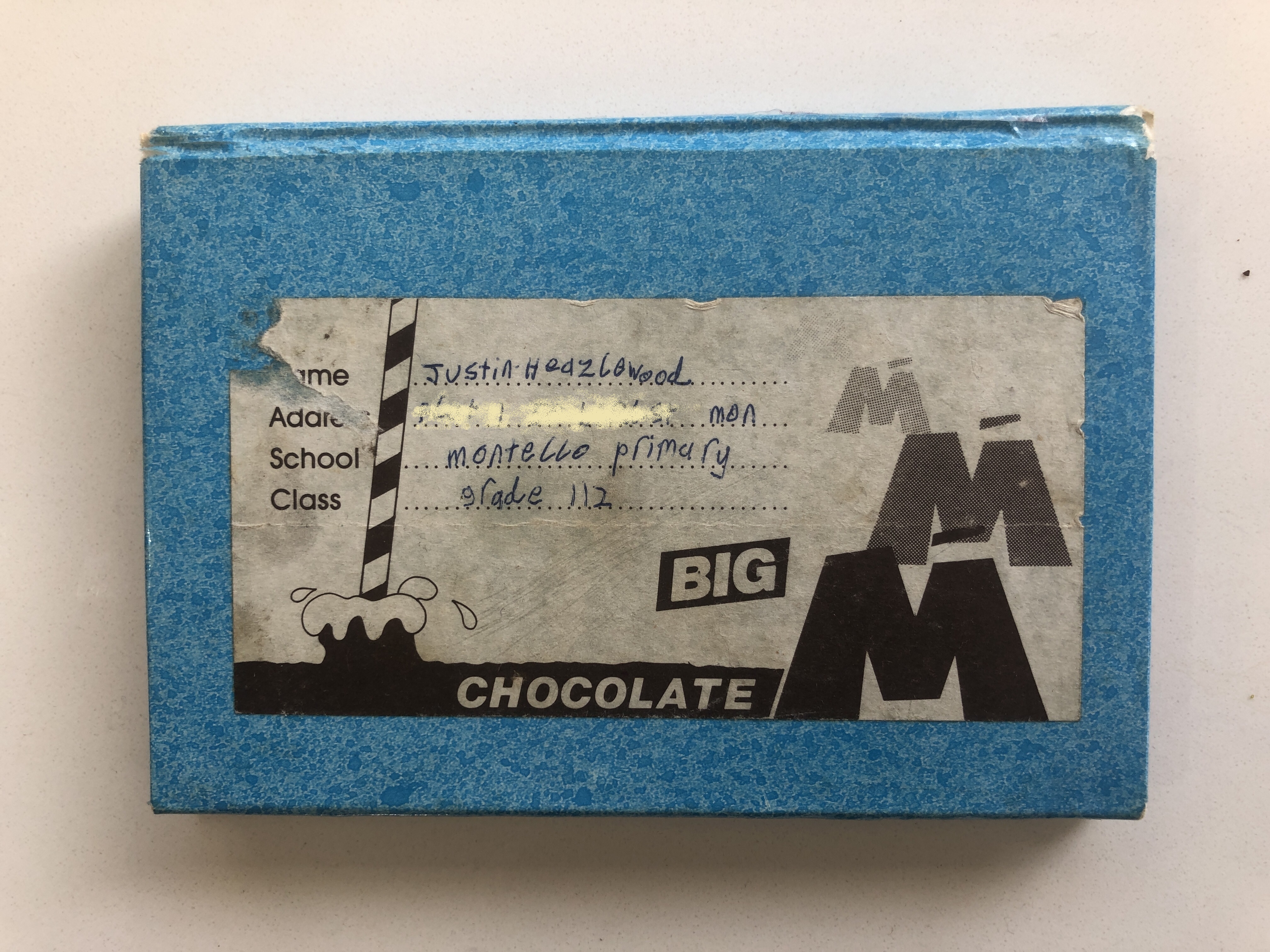
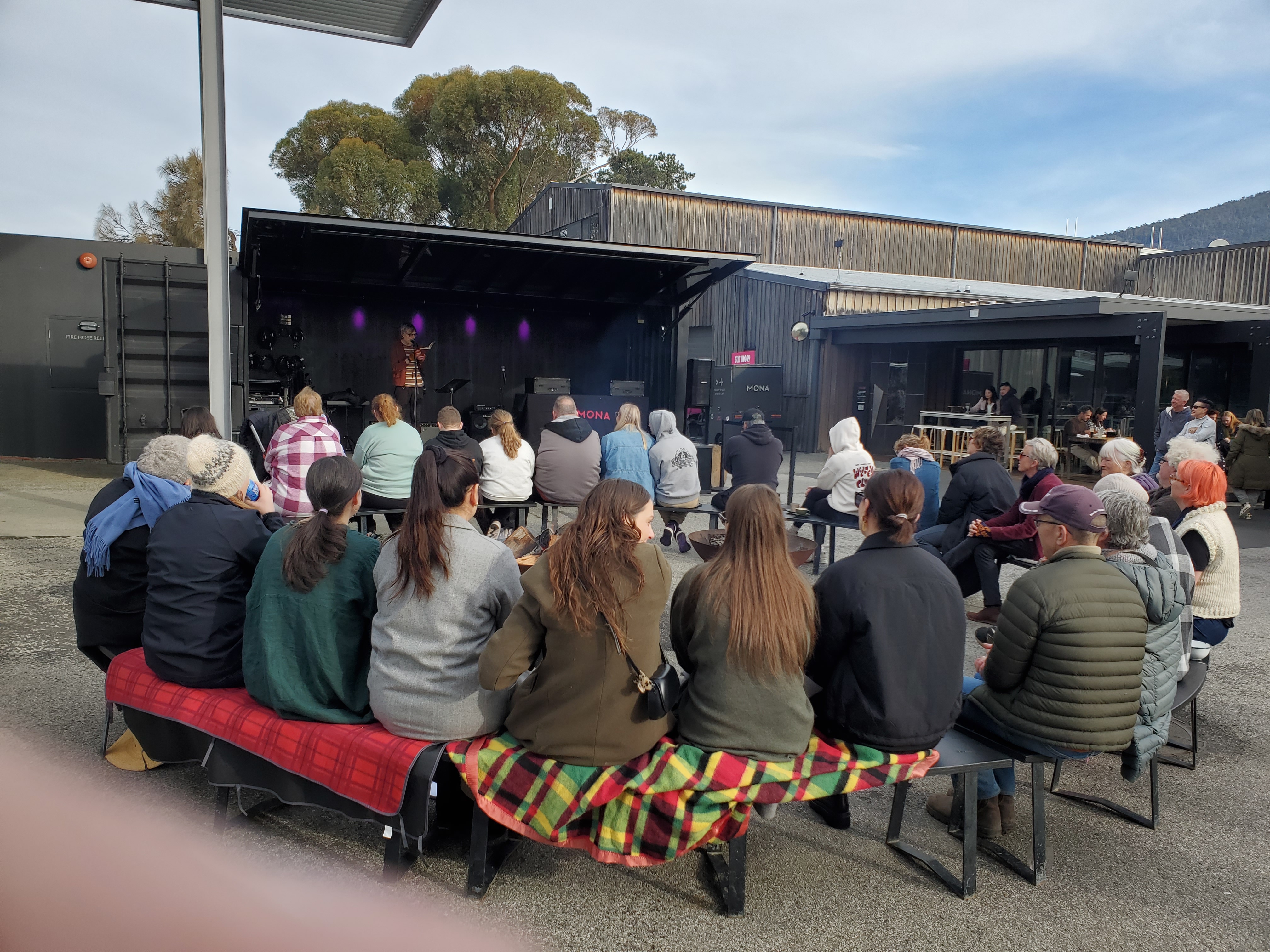
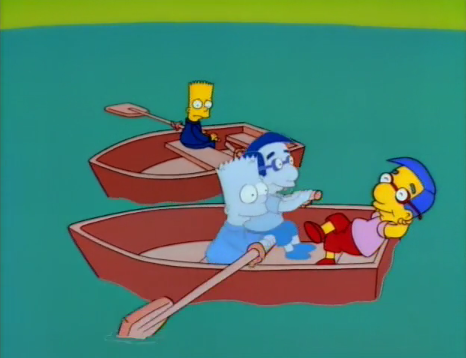
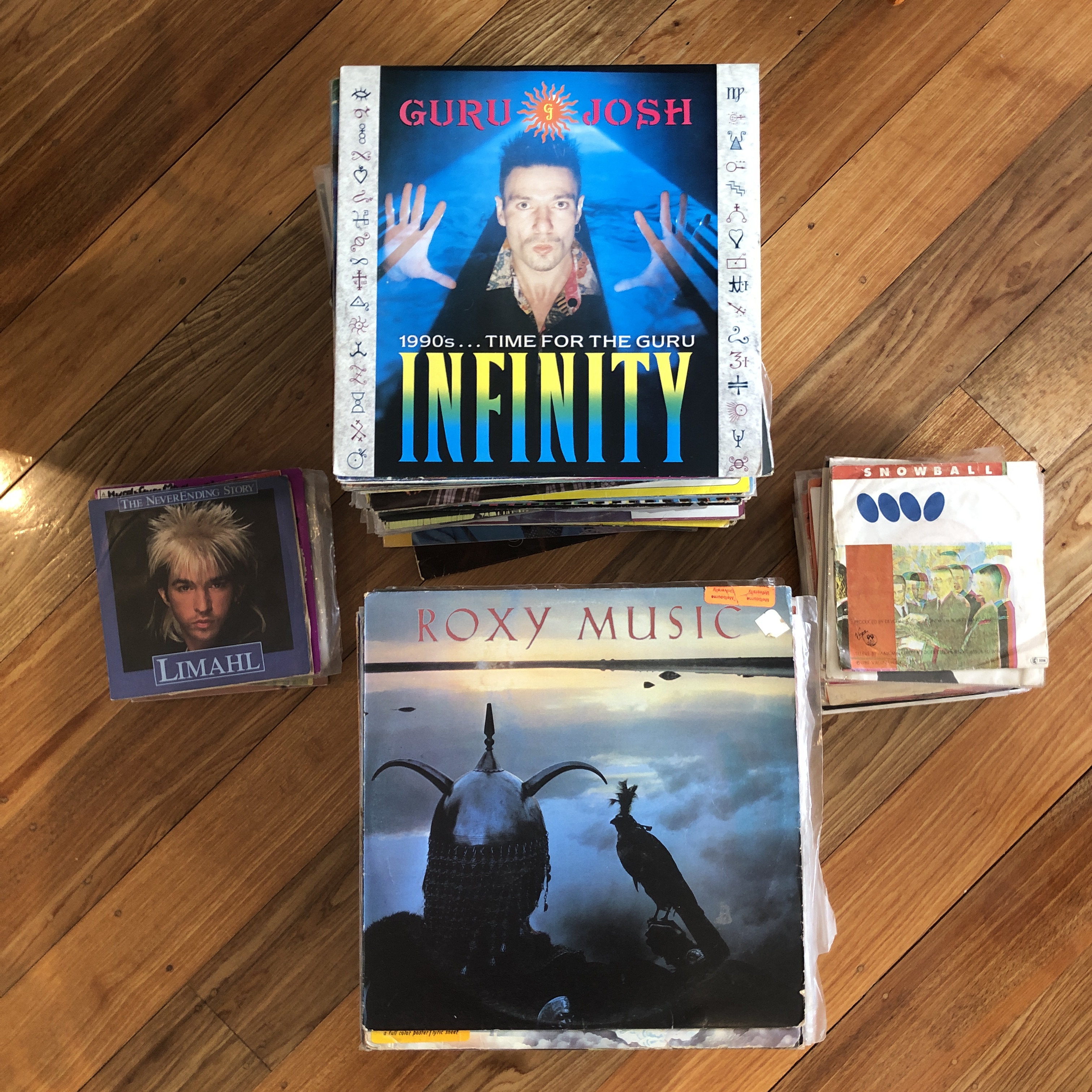
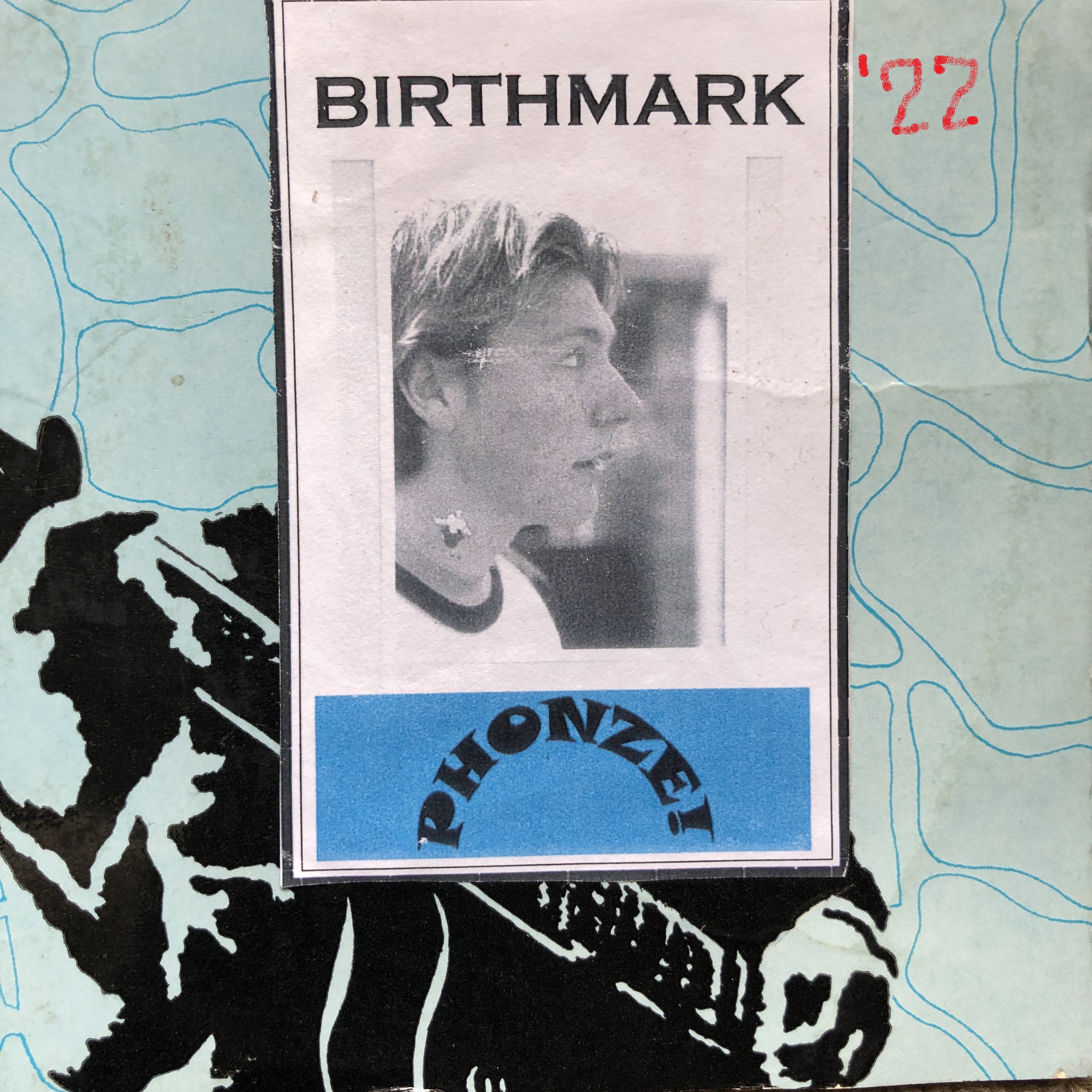
August was poetry month, folks. My piece 13 Ways to Drink Chocolate Milk premiered in the Guardian. and featured in Red Room Poetry’s 30in30. (There’s a video of me reciting it.) In July I dropped a set at MONA as part of a Tasmanian Poetry Showcase.
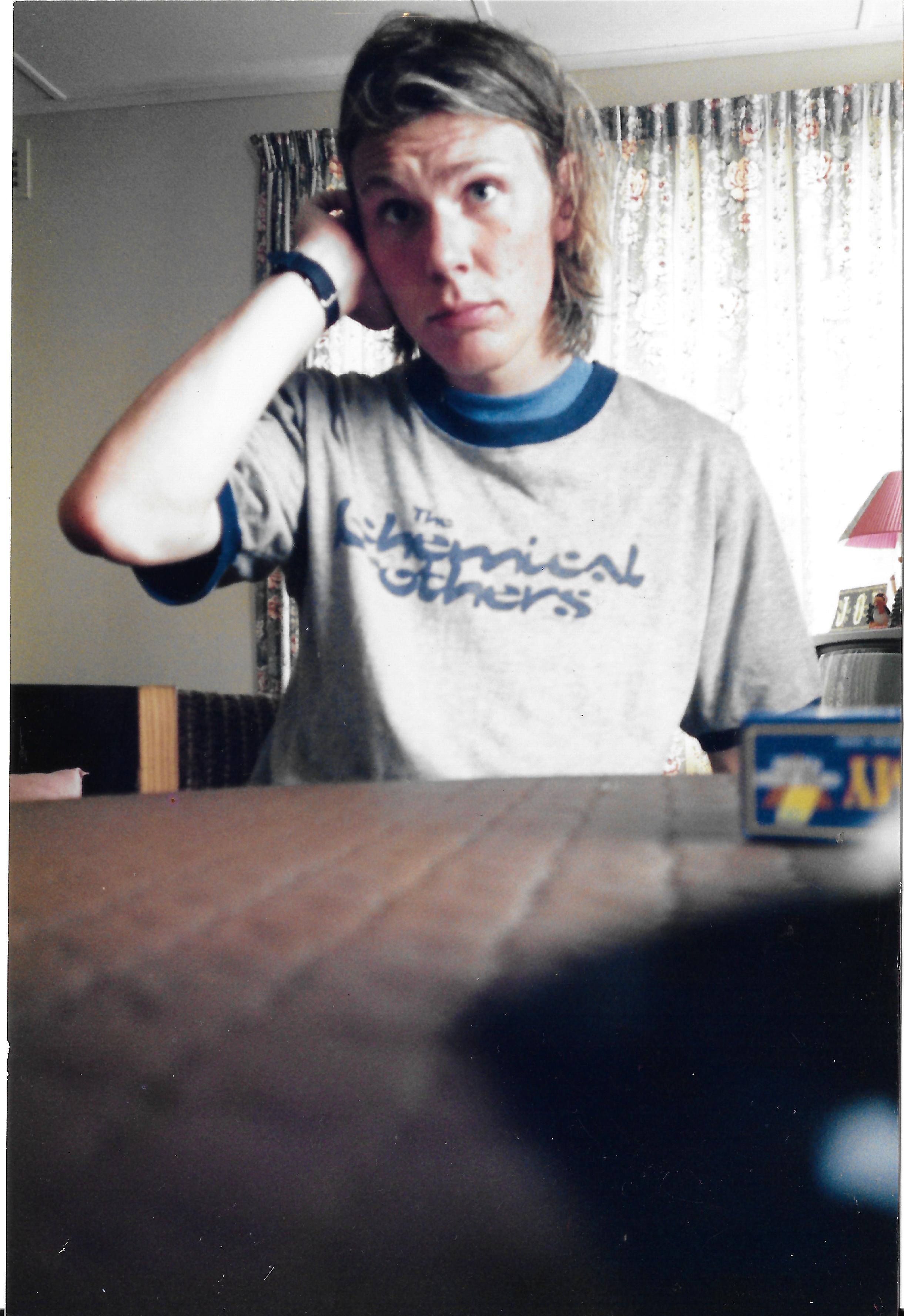
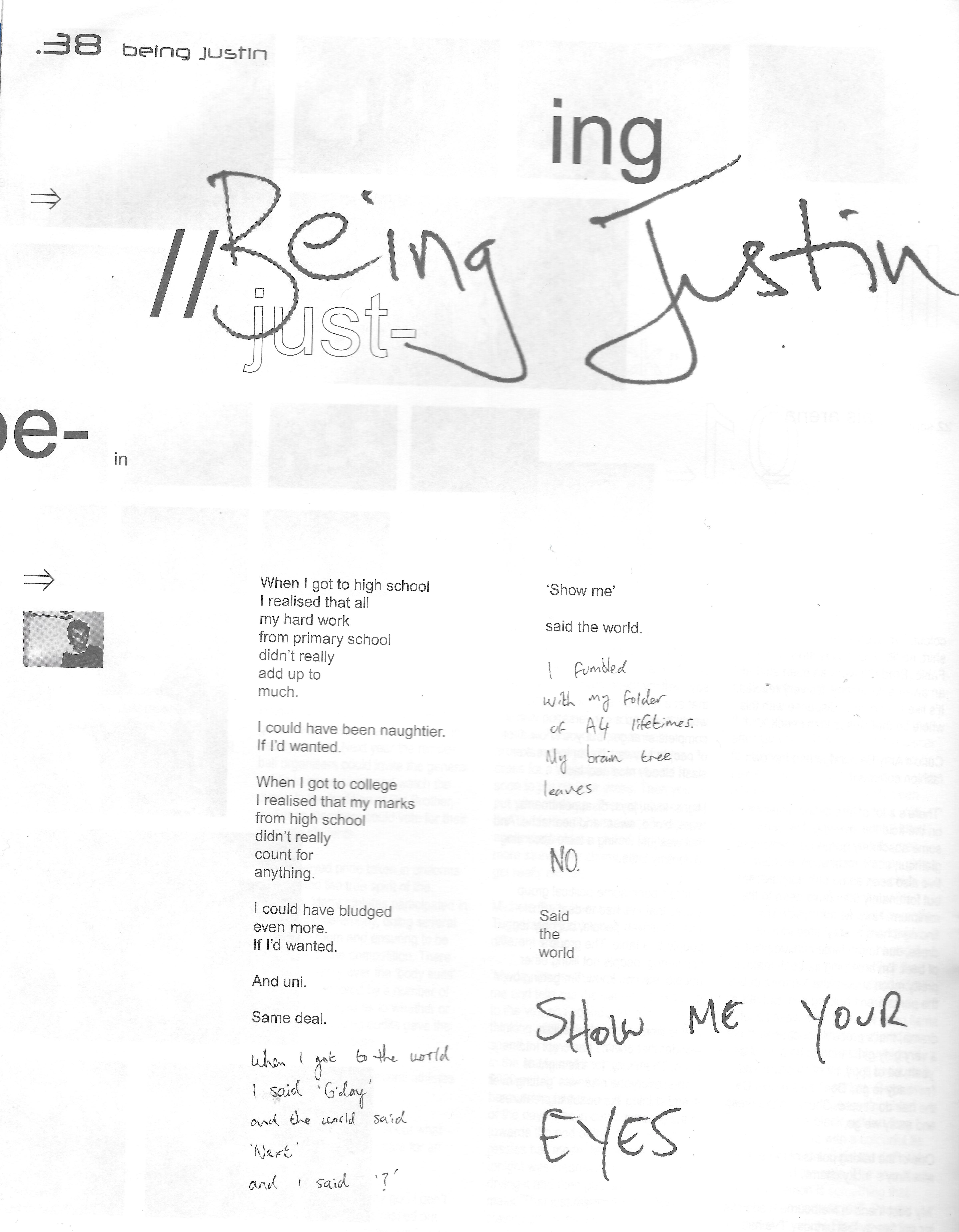
In my final year of uni I had a column in the University of Canberra mag Curio called Being Justin Heazlewood. I wrote this leavers poem:
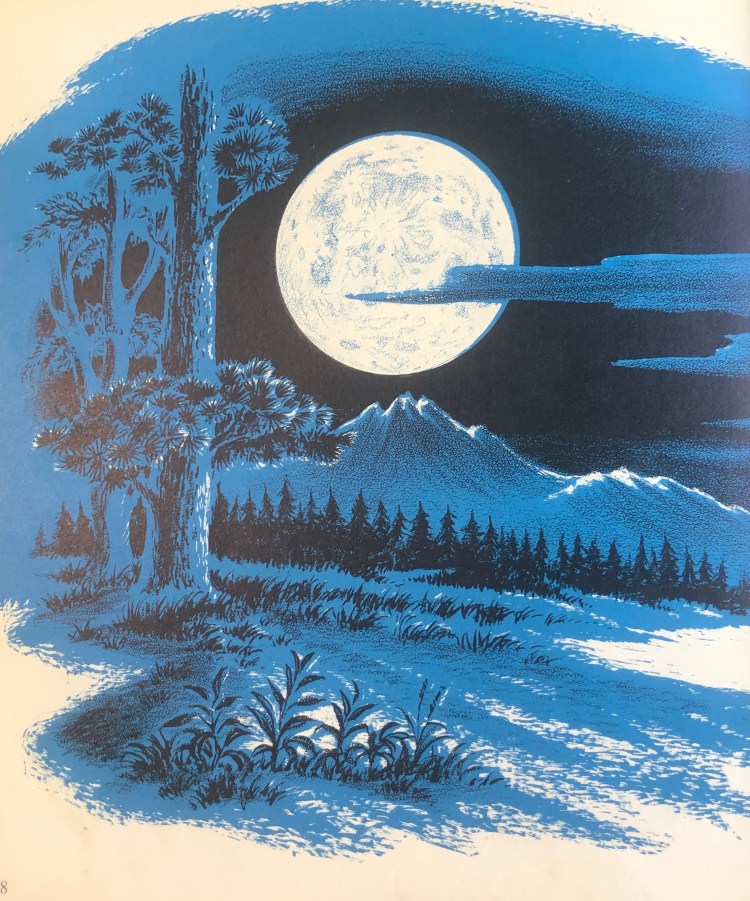
Design by Anthony Calvert.
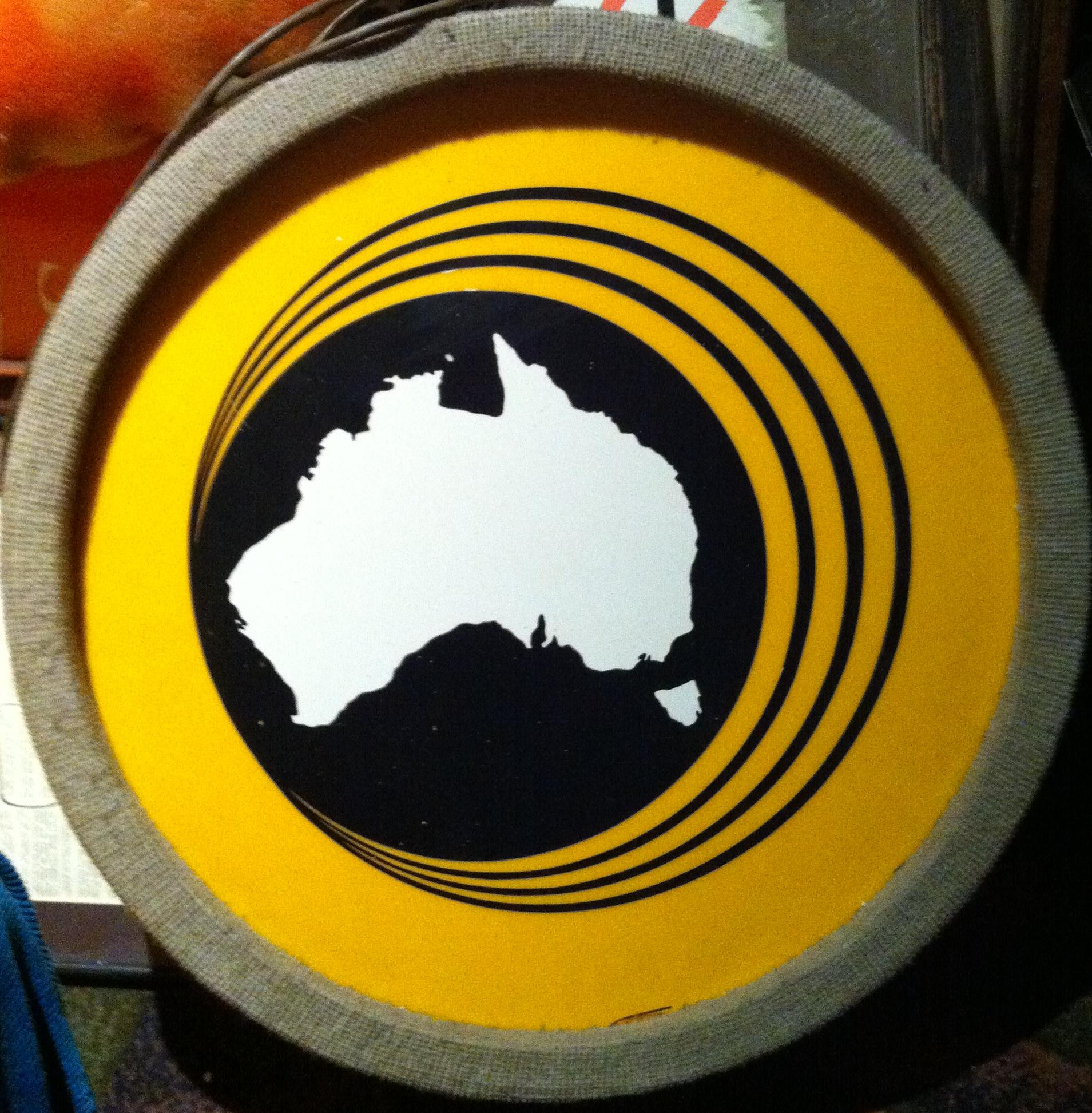
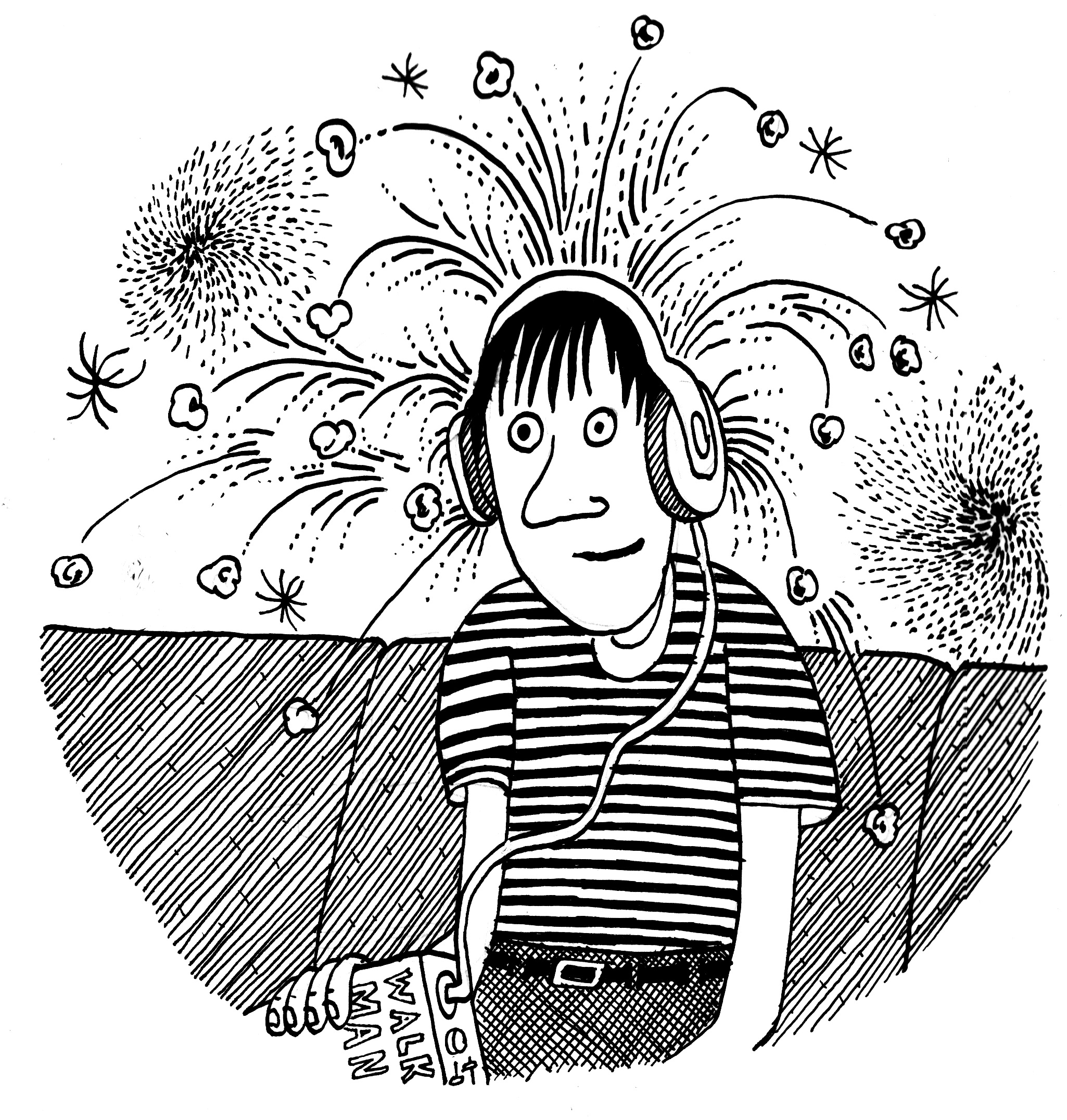
Thinking is Drilling is lifted from my 2018 book Get Up Mum. It was published in the 2022 anthology Admissions: Voices Within Mental Health.
Thinking is drilling
I’m drilling through the walls of silence and confusion looking for clues looking for answers looking for Mum.
I have a lot of work to do.
So I sit and I stare and I think so hard I can cut through the moon because I’m the sun.
Thinking is drilling.
I’m drilling up and out of the rubble. Thinking is making air for myself. A space to survive.
I can think into space into outer space into inner space. I can drill inside deep down and hide. I can drill around in circles so fast that everything’s a blur and I have rings like Saturn.
A drill is a weapon with a pointy tip. I leave it running to rip the black pillows when they come to smother me.
Thinking is drilling.
My mind is always moving. There’s work to be done a maze to be dug a tunnel of fun somewhere deep to bury my time capsule.
My latest book Dream Burnie has an original poem called Truganini Street. I performed it on ABC Hobart breakfast in July.
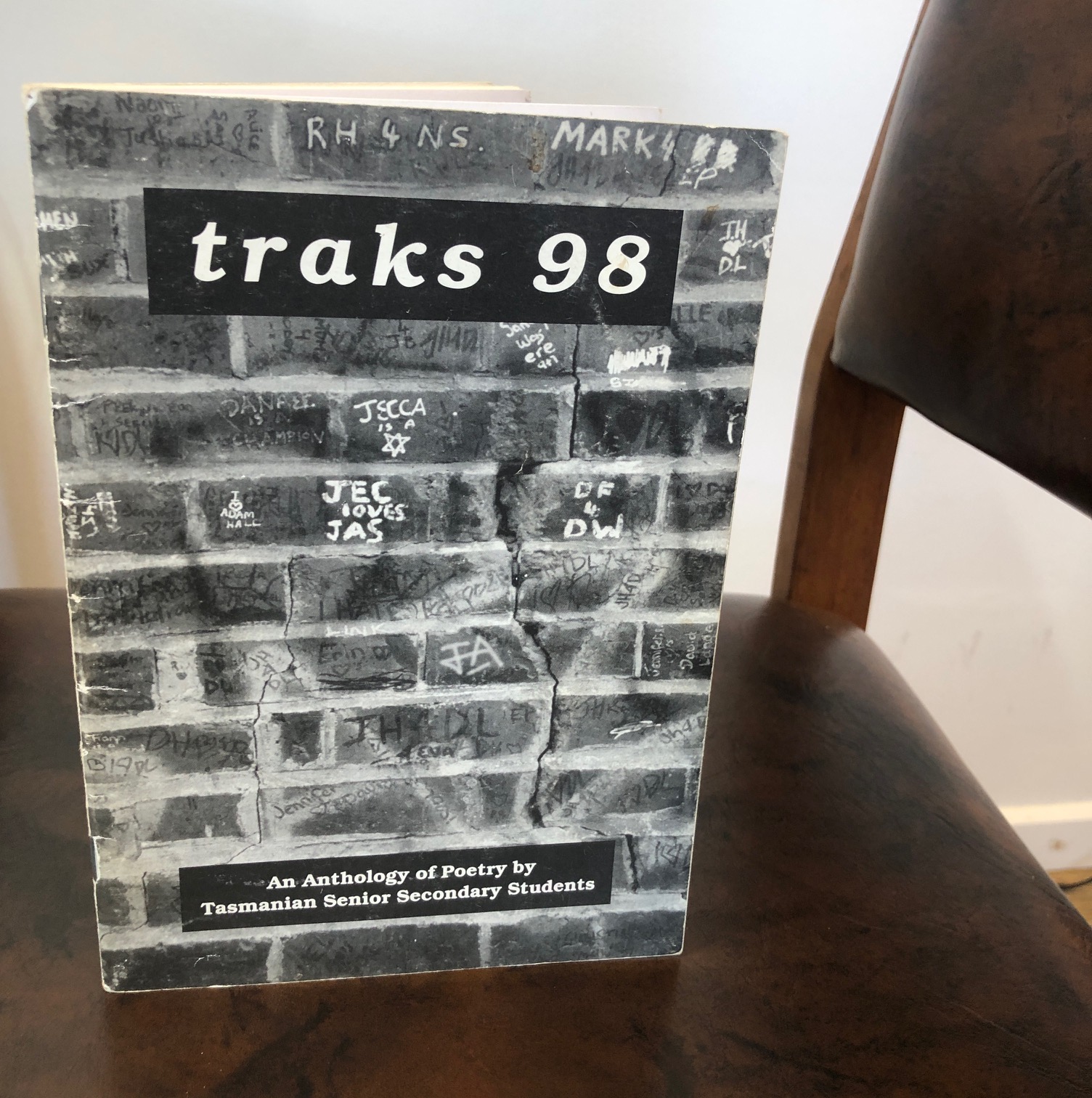
In grade 12 at Hellyer College I was published in a schools poetry anthology edited by Don College’s Shane Wolfe.
Shane wrote in his forward:
“Now that the idea of assessing specific criteria has come to stalk the halls of education, I’ve always thought it rather a shame that there isn’t a criterion eleven anywhere that states ‘Is able to pull off a decent poem that makes you wonder what the person who wrote it looks like and whether that really did happen to them and whether you’d like them if you met them.’”
I was chuffed to get pole position in the gazette. It would be interesting to revisit the headspace that synthesised Journey to the Six Fold Chamber. It’s a psychedelic time. I would be honoured to have a Boags with my eighteen-year-old self.
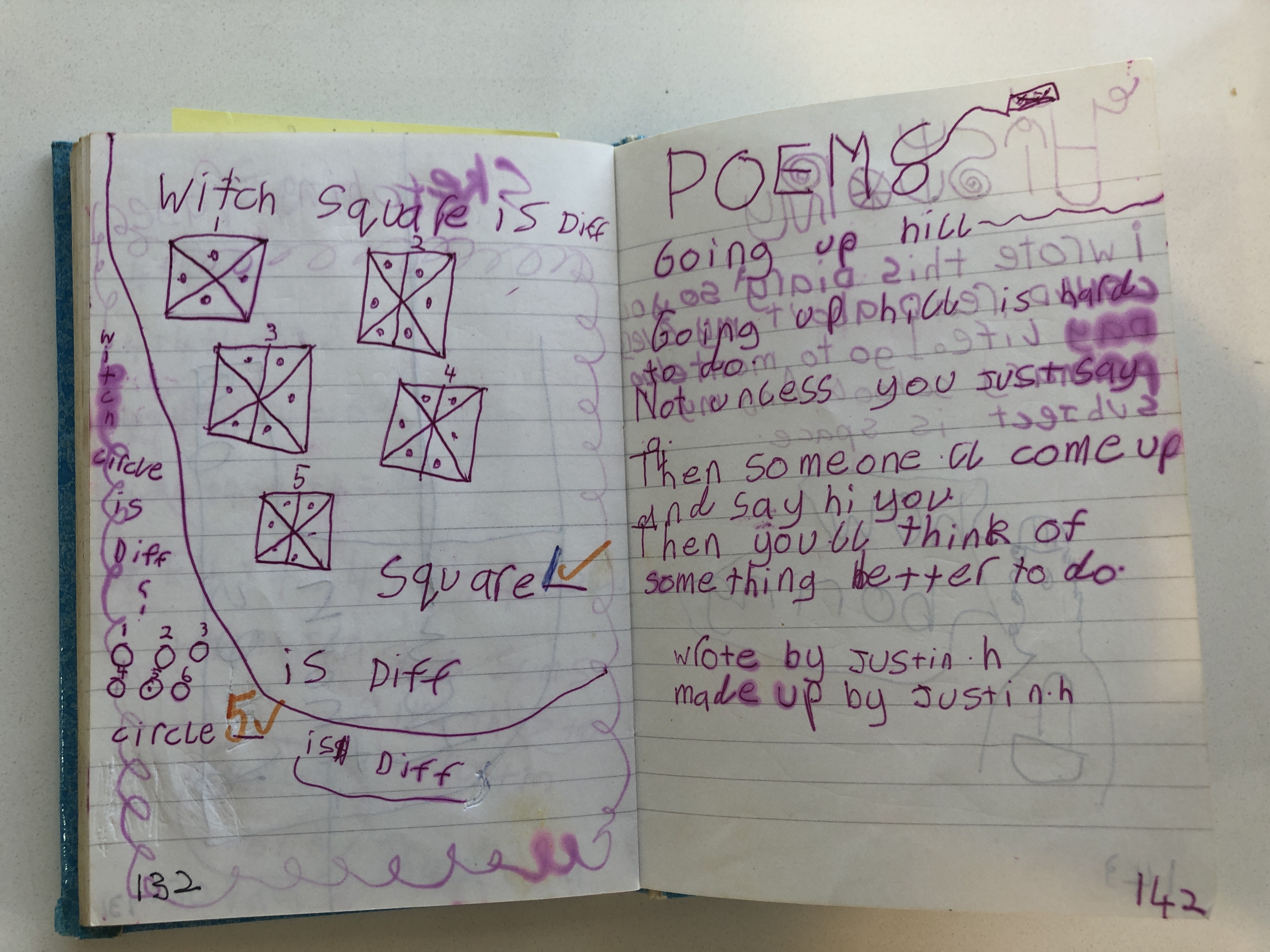
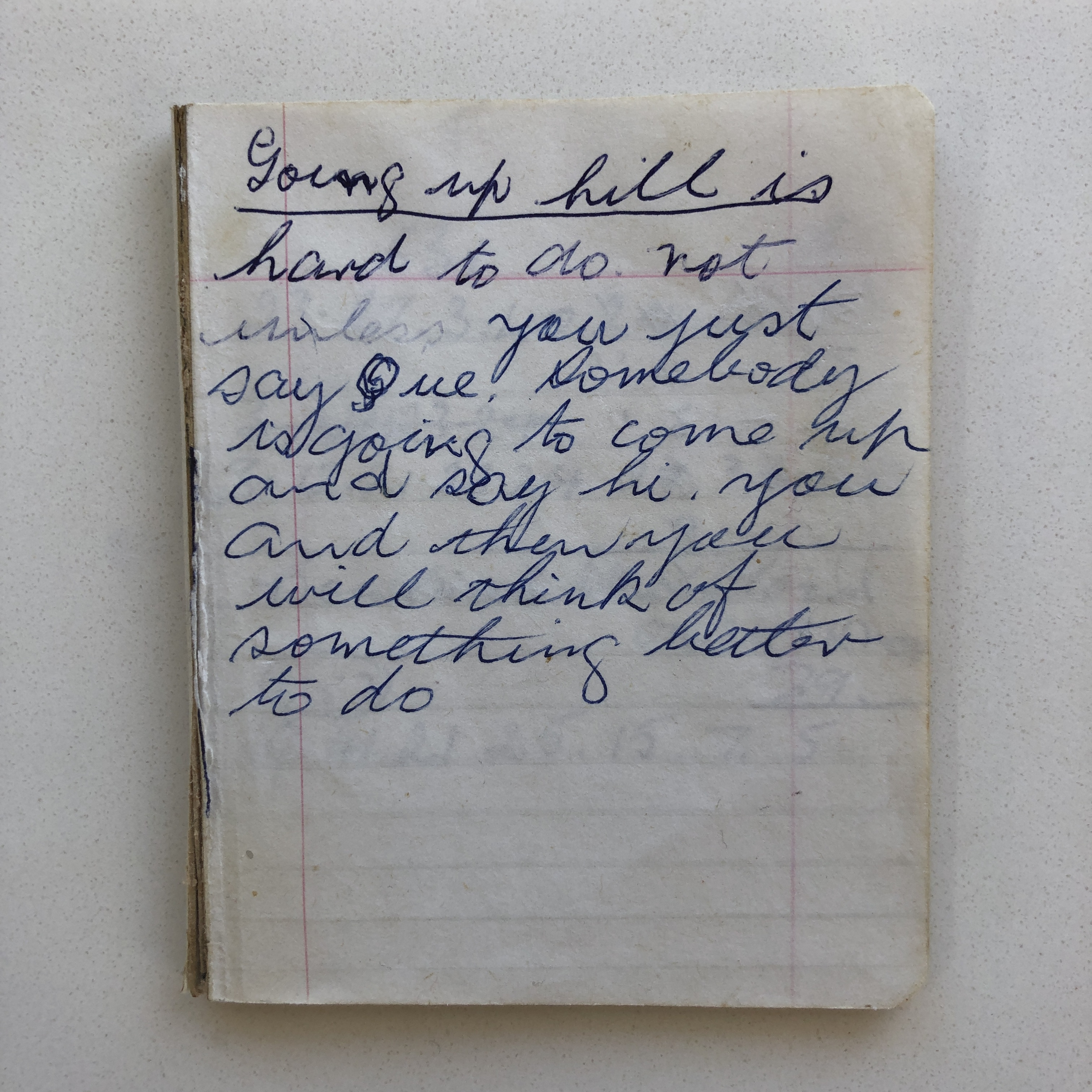
Last year I happened upon a notebook belonging to my Pop. It contained my first poem Going Up Hill complete in his handwriting. It has quickly become one of my favourite possessions. I’m intrigued by the events that led to Pop writing the piece down. Perhaps I was coming up with it for the first time and sharing it with him. It makes me think of the excellent movie The Kindergarten Teacher starring Maggie Gyllenhaal where she becomes obsessed with a five-year-old who spouts genius poetry.
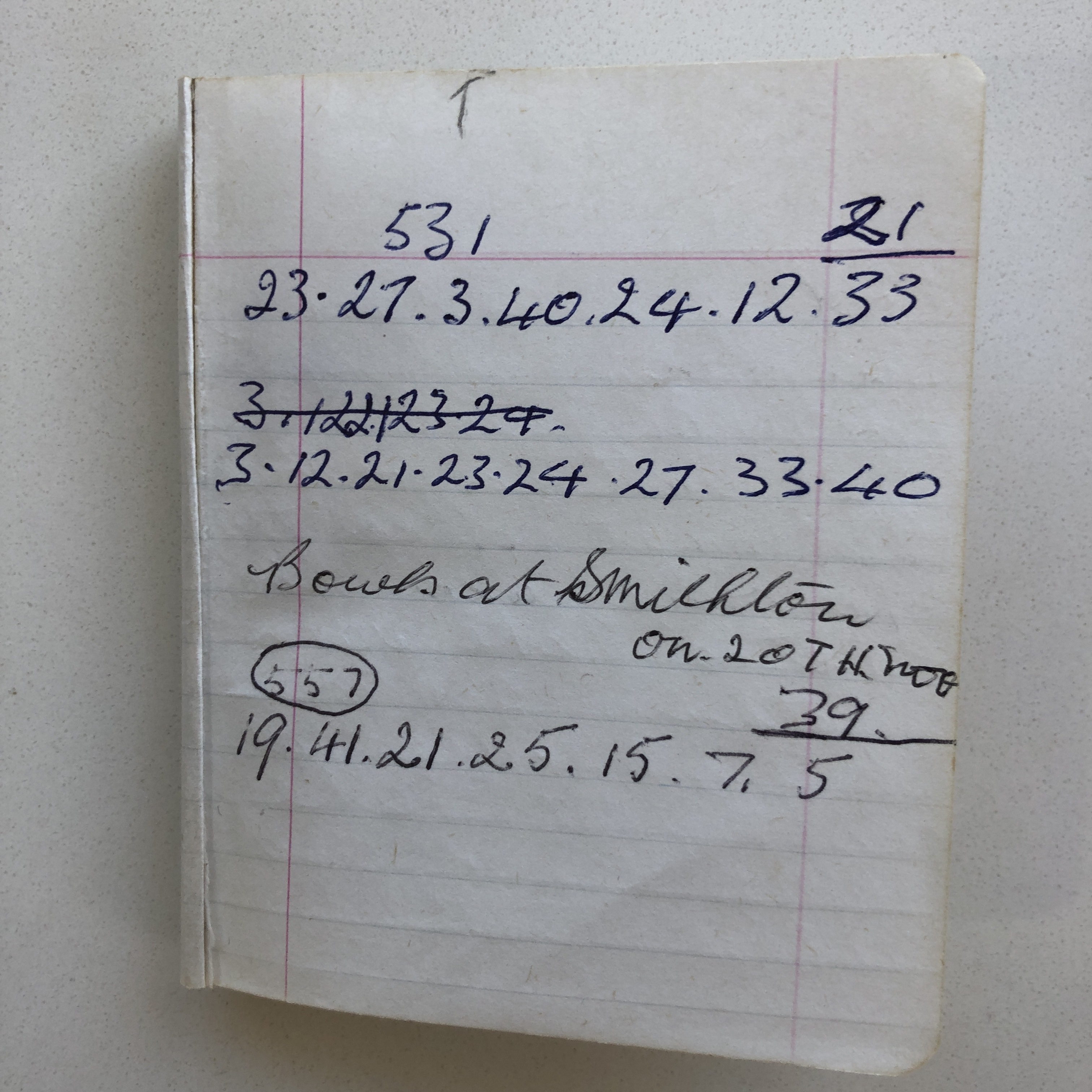
The rest of Pop’s notebook is made up of shopping lists and Tattslotto numbers. I carbon dated it by putting “Tattslotto Draw 531” into a search engine. Sure enough, it provided the date of late 1985.
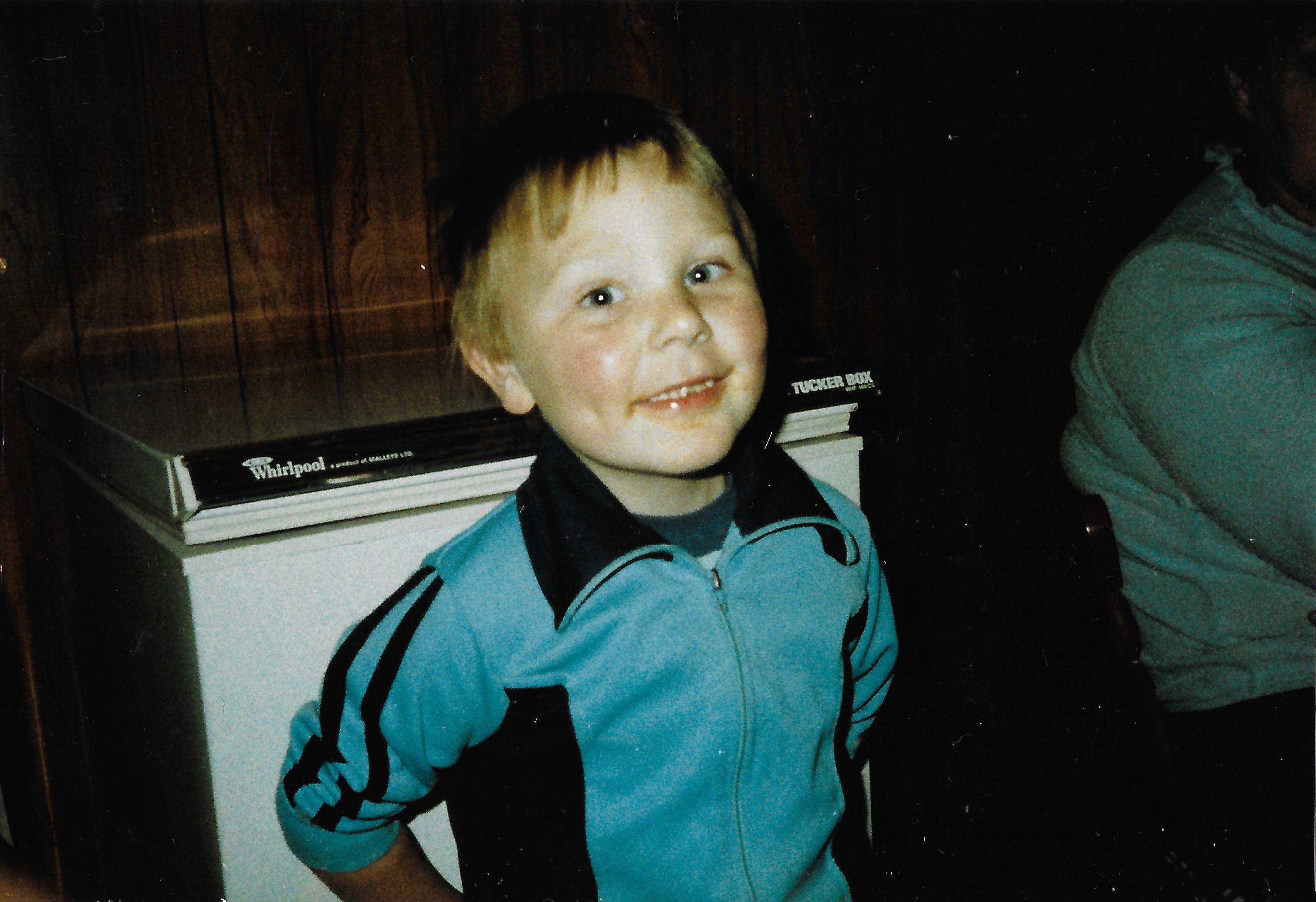
I would love nothing more than to share a chocolate milk with my five-year-old self. (And dear Pop.)
Poetry is an excellent emotional time capsule. Why not bury yours today ; )
Draw a line in the cocaine. This is the moment I exit popular / youth culture. The word is FEELING. Having emotions isn’t funky fresh. I mean, the word vegetables is shortened to veggies, but this is like that process on speed and adrenaline. Don’t get me started on the ISO trend of lockdown. It’s disrespectful to the mental illness community who were experiencing stone cold isolation before and after Covid. Just use normal words around the fundamentals of human psychology so we don’t run the risk of oversimplifying or nullifying them. Feelings aren’t f^%&^g cute, at least not from where I’m cradling them.
DOGGOES / WOOFOS / FUR BABIES
They’re called dogs. We are grown-ups. It’s folksy, it’s hokey, it’s overly familiar and infantilised. It sends a weird message to non-dog worshippers, especially on dating apps. I’m looking at you Dimity, 39.
INTENT
Drinking game: watch the cricket commentary and have a bite of schnapps when Ricky Ponting drops the ‘I bomb.’ You will be morose and plastered by the time Steve Smith has been dismissed for playing some bizarre shot.
LEARNINGS
The language equivalent of a gargoyle who has risen up from the earth to destroy all of mankind. The worst corporate mutation to infect society since the on-sell / thru-connect era of the mid 2000s. Anyone using LEARNINGS should be placed in a vault for retooling. (That said, Max Gawn dropped it on The Front Bar last week and I don’t really fancy taking him anywhere, so free pass for Max if he corners me in a dark alley.)
P.S. The word is LESSONS by the way. P.P.S. I will accept Learnalilgivinanlovin by Gotye.
COSTINGS
See: LEARNINGS. Sounds like it was made up by a small child.
PRESSURE
The AFL would do well to relieve its own ‘commentary pressure’ by pulling the pin and taking a chill pill on the P pill for a pre-set period. If the word pressure was a commodity it would be extracted from a mine in South America by small children, as it has been well over-mined. It undermines what would be an otherwise quite-boring, low scoring modern game.
STRESS
Pressure is to sports commentary what Stress is to TV journalists. Rent stress, food stress, how about syntax stress? Ever considered that hearing the word STRESS every five minutes is, I don’t know … stressful? Lord, get a thesaurus people. Housing concern, food tumult, climate botheration? Those ‘S’s’ are stirring my hypervigilance. Repeating the same word is just bad writing, he said non-pretentiously.
CHIPPIES
See: DOGGOS. Never say this around me or at any other time, unless you still enjoy single digit birthdays. Exception: the musician Wilding because he is English and lovable and I fancy my chances encountering him in a Melbourne laneway.
SUPER
The biggest weed word since ‘like.’ People are ‘super something’ instead of the 36 other choices. Super excited? Super grateful? Why not try uber, ultra, unbelievably or bloody turbo. I am like, super-vulnerable to the innate trashiness of this extremely popular adverb.
Super used to be a point of derision. Remember the impression you’d do of a perky Canadian saying ‘that sounds super!’ Super was going the way of Awesome which raised the ire of wordsmiths for conjuring the tone of an evangelised Christian camp.
Adults inevitably appropriate the language patterns of youth subcultures as society is still beholden to its over valuing of youth. Does social media speed the process up? Or, are you actually young. It’s a pity as Iga Świątek is one of my favourite tennis players and every time she is interviewed she pollutes her unforced error count with a barrage of S***r prefixes.
Am I reading too much into this? Should I get a doggo intent on iso and enjoy some learnings pressure?
Sounds like feels stress.
WORDS THAT SHOULD MAKE A COMEBACK AND BE USED IN A SENTENCE BY A COMMENTATOR IMMEDIATELY
Skedaddle
Shemozzle
Kerfuffle
Notwithstanding (a supergroup!)
Curtail
Mesmerising
Crestfallen
Sun-dried tomato (no wait, this is my sandwich order.)
August is poetry month and Red Room Poetry have selected me as one of 30 poets who will be featured each day. I’ll be performing some of my poems as part of the stanza extravaganza August 3 at MONA, 2-3pm. It’s hosted by Daniel J Townsend, who is a good egg.
My poem 13 Ways To Drink Chocolate Milk will also be published in the Guardian at some point during August. Follow my online interactive sharing squares to catch my piece as it drops. More info HERE.
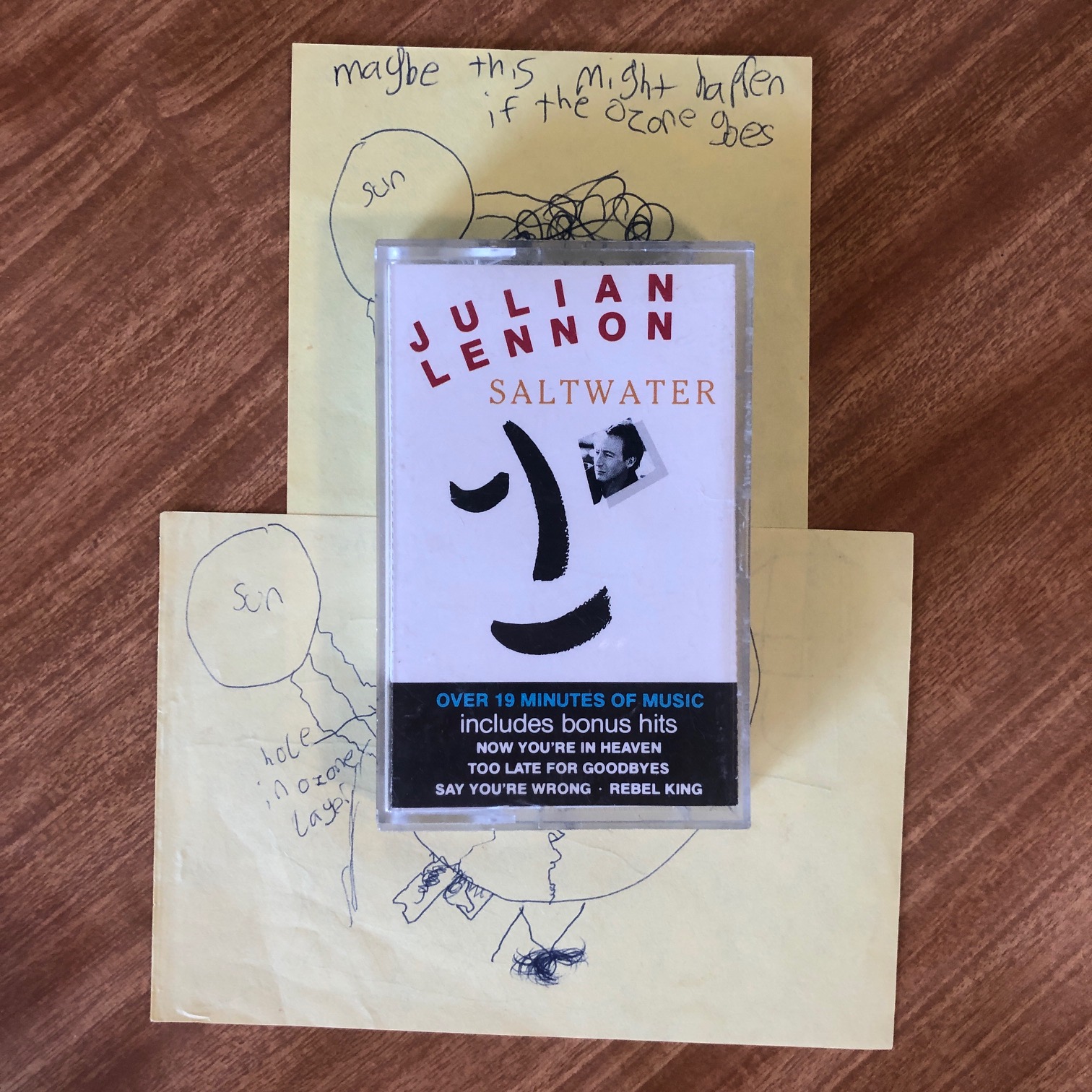
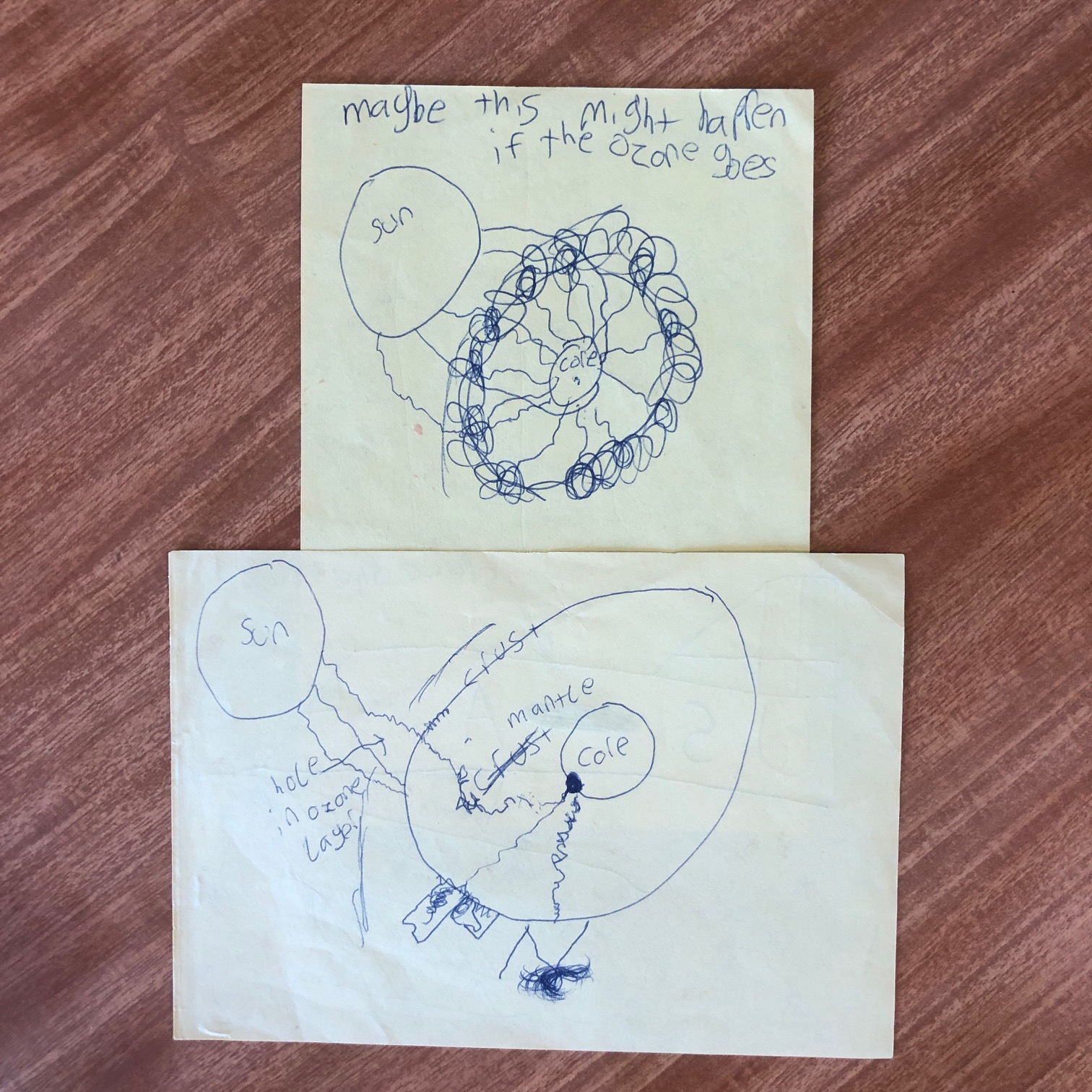
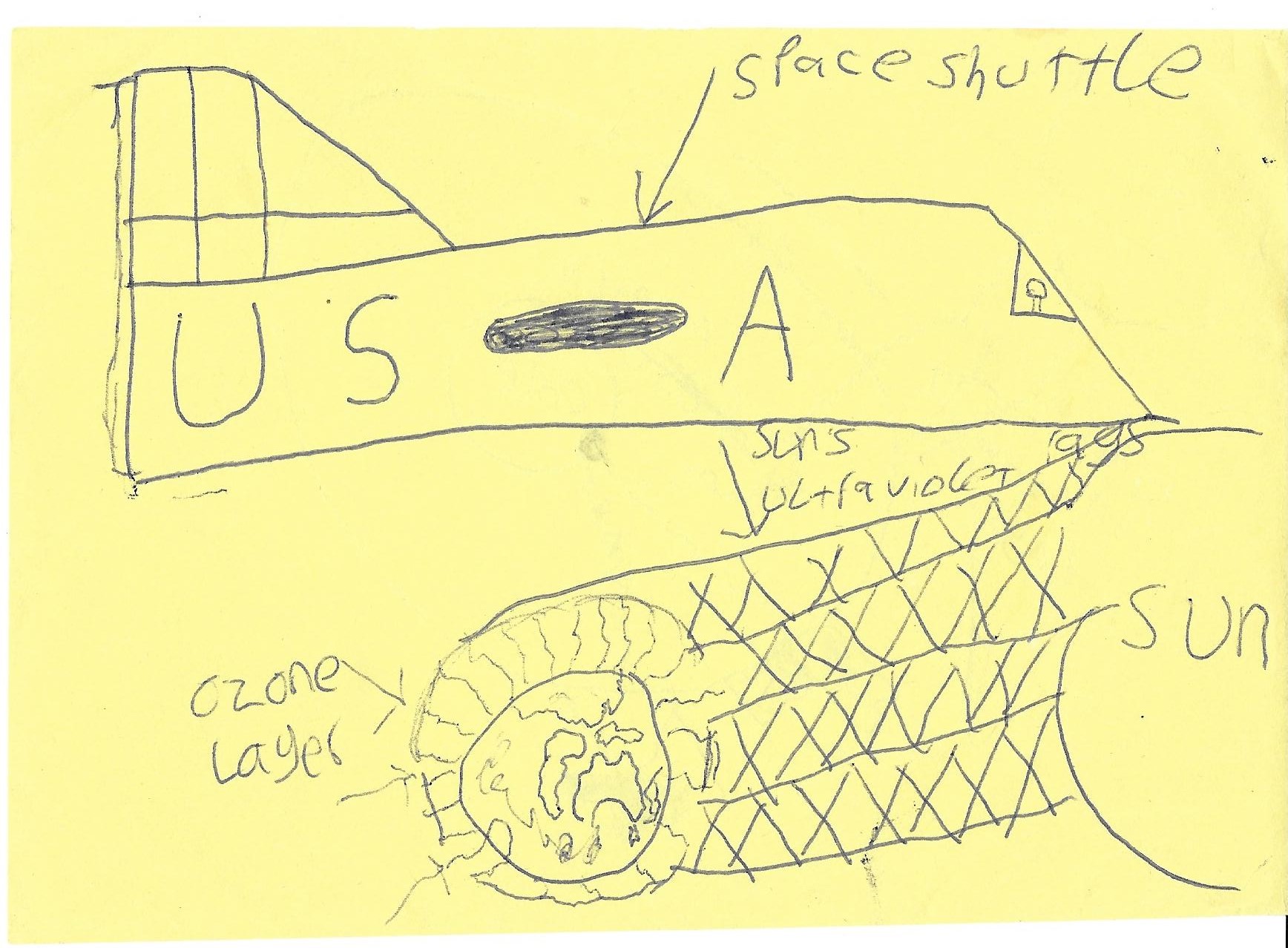
I have a piece in The Monthly. It is about Julian Lennon and the ozone layer. It is also about Burnie and sometimes Captain Planet. It is about male emotions and men crying. It is for the ‘Life Sentences’ column in which writers riff on a catchphrase, lyric or quote that has loomed large in their life. John Safran has done it also. Check out the March edition with Kim Williams on the cover.
FUN FACTS:
My piece contains research from a forthcoming book I’m writing about Burnie.
I always assumed George Harrison played the solo on Saltwater. Not true! It’s actually Steve Hunter. George played a demo, which Steve replicated. George was busy consoling Eric Clapton whose son had just died.
Saltwater debuted on the Australian charts in late 1991 and went to number one in March 1992, (knocking off Euphoria’s Love You Right.) It was a slow-climb, eleven weeks in all. (It peaked at #6 in the UK and barely charted in America.) Saltwater held the top spot in Oz for four weeks (impressive!) before being ursurped by….wait for it…
The 12th Man (featuring MCG Hammer) with Marvellous. Super effort that.
This is my Monthly debut. My previous appearance in Schwartz media was when Get Up Mum was reviewed by The Saturday Paper.
Water divining is also known as ‘water dowsing.’ It’s making a comeback according to this ABC story.
I bought the Saltwater cassingle in 2020 as research for the Get Up Mum theatre show. (If you leave me in a room and give me an arts grant I will go online and purchase cassettes.) The tape is good value as it acts as a ‘Greatest Hits EP’ – mirroring a gag from Northcote (So Hungover).
The Monthly doesn’t allow single quote marks, as a rule. I originally intended for the word ‘blue‘ to appear as so.
If you would like more information about the status of the ozone (courtesy of Tas. artist Sarah Howell), this article talks about the 2018 CFC emissions from Chinese factories. This article acknowledges the effects of the Hunga Tonga eruption from January 2022. Finally, this 2019 ABC story speaks specifically about the hole in the ozone myth and the sun’s vibes in Tasmania.
Illustration by Leigh Rigozzi
Why should one baby feel so hungry she cries? Fair point. Babies do tend to cry when hungry, as a rule, but pedantics over songlyrics is a fraught exercise in long-bow drawing and goal-post shifting.
I know what Julian means. How is that huge famine going in Yemen anyway? In 2024, over 18 million people (half the population) will need humanitarian assistance. Much of the food insecurity was caused by war. So – to site Julian’s Dad – all we are saying / is give peace a chance is still a valid mantra.
Anyway, I’ll stay in my lane. Hyper-local non-fiction with witty puns from the nineties. Please follow this wordpress site (bottom right-hand corner) and subscribe to my mailing list HERE.
Julian Lennon update: Having lived for love (and a rockstar career), he’s known as more of a photographer these days. He received so much grief about aping his Dad’s upper register that he didn’t pick up the guitar for seven years. (Tame Impala gets away with it, but has the advantage of biological independence.) Unfortunately, Our Julian went through a bit of an ‘anti-vaxx’ phase along with Eric Clapton. *sigh* Never meet your heroes (online).
He released a new version of Saltwater in 2016 called Saltwater 25. He said things like ‘it’s still relevant, now more than ever’ which, as you know, is ‘true.’
Burnie had a mini oil-spill in the sea only a few days ago! As per the Burnie Council’s FB post: “The polluted water advisory from Council follows an incident involving a delivery truck at Target, resulting in diesel fuel entering the Council’s stormwater network. In consultation with the EPA and TasFire, to ensure the public’s safety, the affected drain was flushed, resulting in the discharge of contaminated water at West Beach – just on the Western side of the playground.” Yikes. There just happens to be a major Little Penguins rookery there. Saltwater wells in my….well, you get the picture.
Actually, I haven’t cried since I watched All of Us Strangers at Westgarth Cinemas – but that was only because I was a on a date going nowhere slow (much like the film).
I wrote a column about my love of arpeggiated synths for music site Mess+Noise in 2011. Since then, I’ve observed the explosion in popularity of what has long been my favourite sound in music. In short, it’s a run of synthesizer notes that groove back and forth – sparkling, colourful, magical and mysterious. The audio equivalent of a palindrome. A mirror image wave form, glowing and sparking on loop like an enchanted roller coaster.
Here’s a quick example – the spritely business partying up the back of Lionel Richie’s Dancing On The Ceiling as demonstrated:
The most popular example of recent times is the Stranger Things opening theme which dropped in 2016. A good example of the slower, more agitating end of the arpeggiator spectrum.
Like the show (set in 1984), the theme was a throwback to a time when pop songs like The Never Ending Story and The Riddle (both released in ’84) and There Must Be An Angel (’85) had a melancholic sonic blowwave wafting ephemerally through the back of the mix.
In 2013 my favourite band Boards of Canada utilised their biggest batch of arpeggiated synths to date in a 1980s John Carpenter soundtrack tribute Tomorrow’s Harvest. Like Stranger Things, they took the warm cosmos of the Popcorn sound and reduced it to a steely, robotic chill.
To me, arpeggiated synths are the sound of infinity. The glorious, cascading, expanding universe of my imagination. The spiritual projection of what I imagine an all-star all-flying glittering afterlife to be. The Never Ending Story’s Fantasia meets Mario Kart’s Rainbow Road.
A frosted, pulsing rainbow run.
Echo nebulas, rebounding through the galaxy.
Fireflies of sound, synchronised like hexagons.
In 2011 arpeggiated synths were thin on the ground in alternative music. There was my favourite song of all time Infinity by Guru Josh, in which he synth-bombed a whole decade with his audacious lyrics and a (count it) two minute piano solo. In grade ten I requested Infinity as part of my ‘Hi 5’ favourite songs of all-time played by Michael Tunn on Triple J! For a long time the only copy I had of the extended mix (which wasn’t on the CD album) was the cassette recording from the radio, including the bump where I accidentally pressed record.
Infinity contains what I believe to be the best 20 seconds of recorded music, ever. [2:06 – 2:25 of the 12” version]
For the rest of the nineties the only place to find arpeggiated synths was in remixes of obscure techno songs like Pizzaman’s Happiness. 2000 marked an indie-rock retro explosion as Grandaddy brought the arpeggiator love on their landmark album The Software Slump. Tracks such as Crystal Lake were striking for the juxtaposition of synth used in a rock song. (The origins of which could be traced back to 1972’s landmark single Virginia Plain by Roxy Music, the same year that Popcorn was released. Pink Floyd’s Dark Side Of The Moon would appear the following year). Radiohead, having successfully married computers on Kid A were soon joined by Wilco with Heavy Metal Drummer and in five years LCD Soundsystem would take the dance/rock fusion full circle.
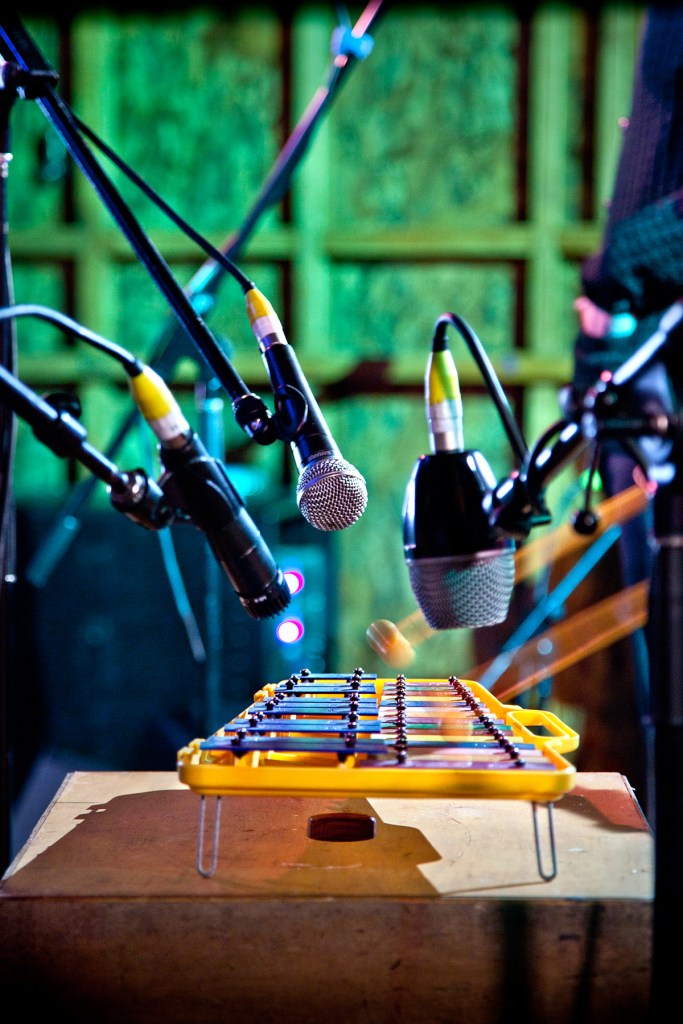
If xylophone is “the music you hear when skeletons are dancing” (Homer Simpson) then arpeggiators are the sound of a unicorn galloping.
Sometimes I’m asked whether I’ve ever wanted to make my own synth music. Unfortunately I’ve never afforded my own machine to play with. It’s a sweet dream with a long tail. I picture myself locked away in a strawberry-lime studio with lava lamp, buggy posters and velour robe, crafting my own downtempo ambient electronica like a sporty Tasmanian Jean-Michel Jarre.
In 2012 I made an unreleased album working with Melbourne cult-electro wildman SPOD (Brent Griffin) and my favourite psychedelic songwriter Richard Cartright of Sydney’s Richard In Your Mind. SPOD had a vintage Micromoog, the kind of which Popcorn was no doubt composed on. It looks like the dashboard of Dr Who’s Tardis and is about as abstract to operate.
No ‘demo’ button here. You twist knobs and dials, squashing and squelching the soundwaves like a lightsaber manipulator. I watched SPOD with awe reserved for the Level 20 teenagers at my kiddie video arcade. This trucker-capped wizard of rhythm flounced and flocked the unit until it was growling and flanging with the savageness of Tom Morello’s guitar amp.*
Richard had an Oberheim synth with 100 prebuilt effects. He was soon able to recreate the impossibly warm sounds of everything from Take My Breath Away to Great Southern Land. It was exciting just to be in the same room as the equipment responsible for the friendly radio ghosts of my childhood. These unsung studio sentinels evoking the underlying longing and lunar loneliness that make up the soft padded bed of my eighties nostalgia.
Oh yeah, I got to play with synths on my 2009 album Brown & Orange. Hanna Silver had a retro Korg with some delightful presets. The most notable use was this track, which was always a bit of a messy record favourite.
And now, the original column from 2011 followed by some recent examples of my favourite arpeggiated synth based tunes, featuring the likes of Daft Punk, Beach House and Gorillaz. You can make your own arpeggiated sequences on this Online Sequencer if you wish. Dig.
TREBLE TREBLE // POPCORN AND INFINITY (2011)
illustrations by Leigh Rigozzi
My first memory of music is listening to Popcorn by Hot Butter. I’m standing beside Nan and Pop’s ‘Stereo Sonic’ entertainment deck with black sponge headphones wrapped around my noggin. I load a cassette into the deck and press down on the chunky metallic button. The oceanic tape hiss fills with a sci-fi whine, followed by a warbly synth waddle of baroque alien ducks and the novelty combustion of a robotic, whistle-ready melody.
I sit mesmerised, staring at a yellow and brown swirl print cushion. These sounds are colour to a blind man. An aurora to a caveman. A Christmas and birthday imagination sandwich. Cerebral sorcery that fits like a tshirt and springs like a trampoline. Music was shaking hands and asking to be my friend.
The song continues, the pad chord bed hitting the profound F#m. The vibrations enter my ears like molten fireworks then vapourise, leaving puffs of awe. Popcorn, at once silly and profound, is a Moog minstrel with a weeping heart. The jaunty lead tickles my chin while the broody rhythm of the bridge places a steady hand on my chest. The song is trying to tell me something.
At 1:08, something incredible occurs. The carriage of the song slips off its rails and sails into the air, gliding on a glitteringly gorgeous magic carpet of harpsichord and arpeggiated minor chords. The chords are broken down to their base notes and knitted back together to form a musical spine which flexes and flickers, like the tail of an electric dragon. The sonic flux swings and snakes, mirroring the waves and mountain tops of a stereo equaliser. The luck dragon cycles its way through the dazzling axis of my mind. Lava coated flowers burn red, blue then yellow. My LCD creature zips and darts, spelling mathematical shapes before exploding into rainbows and lightning rods.
After this uplifting bridge the song breaks down into the tribal simplicity of tom drum and tambourine. An anxious two-note timer synth creeps in, adding a sense of urgency. Each layer of instrumentation is cleared, leaving only the ticking of a laser clock, soon blotted out by the squelch of Martian flatulence. It is at once comical and menacing. The sound of a spaceman being obliterated in a Commodore 64 game.
I take off the headphones and gaze at the rows of tapes and photo frames, my head slowly morphing back into shape like ear plug foam. What is this “music?” This kaleidoscope of sounds. I am caught hook, line and syncopation.
My second memory of music is listening to I Just Called To Say I Love You by Stevie Wonder. For this six year old, the song is trumped by the micro-single which opens the tape. The XDR Test Toneburst that sits at the beginning of cassette albums from the era. An audio distress flare sounding out the basic spectrum of tones from sub bass to high treble. An arpeggiated fantail for my brain to decode.
The song plays. I am drawn to the warmth of the synths, blending sweetly with the early 80’s compression and Wonders rich voice. Listening back, I detect lightly arpeggiated notes in the mix, adding a mystical, tinkling ambience – crystal rain on glass. (A similar effect to The Never Ending Story.) The song has a lightweight of melancholy I am drawn to, and while my emotional palette is primitive, my synaesthesiac instincts associate the thick pad of the minor chords with a quiet internal warmth, as my heart increases the blood flow around my body, sending a rainstorm of thoughtfulness to my tummy.
Being a child of the 80’s, it’s little wonder my earliest memories of music are mostly synthesiser based. A glance at the children’s programming of the time shows cult classics such as Ulysses 31 and Mysterious Cities of Gold using the kind of synth-heavy soundtracks that Gary Numan could take back to his laser pyramid. I recently rewatched Mysterious Cities of Gold and found to my delight that not only had the animation aged gracefully, but the soundtrack was a full bodied tremolo dreamscape.
One of my first cinema memories was the opening credits to The Never Ending Story, featuring the title track playing while the camera tracked over dreamy clouds. While the single already contained brilliant melodic structure and a rousing chorus, my brain was excited by the arpeggiated bed, sublimely oscillating in the background like robo piano roll. Coupled with the epic adventure of the film, The Never Ending Story made me want to melt from happiness and sadness all at once. Add the prettiness of the childlike empress, the savagery of the wolf and ARTAX! and you have an original sex and death soundtrack with training wheels.
A few years later, in 1990, I would accidentally bump into the greatest arpeggiated synth sequence of all time. The song was called Infinity by the UK artist Guru Josh. The song revolved around a melody played on saxophone utilising a stirring F-C-G chord sequence similar to that found in Manic Street Preacher’s If You Tolerate This, Live’s Lightning Crashes and Scatman John’s Scatman.
Behind the sax are heavenly orchestral pad synths punctuated by a subtle oscillation of notes, brilliantly complimenting the chord sequence but not yet fanning all the hues to its peacock tail. It’s an ambitiously anthemic and acutely ambient opening, especially when listened to through earnest young ears.
The verses comprise of Guru Josh staking audacious claim to the entire decade “1990’s – time for the guru” backed by some industrial Terminator-esque effects and scattershot house beats. A looming three note bass line keeps the track in check while Guru Josh scats some ‘oohs’ and ‘aahs’ landing somewhere between Max Headroom, Kraftwerk and David Koresh.
At the two minute mark of the extended mix we are treated to a twenty second burst of what I have, for most of my life, accepted to be the greatest section of music ever recorded. The chorus chords are reprised with an arpeggiated lead running brightly over the top. The stirring ambience of angelic electro wash, flush with a dramatic major to minor chord change are punctuated with a constellation of digital train tracks whose rise and fall evoke the exotic quasars of my spatial awareness. It’s like a squadron of effervescent sprites line my kinetic pathways, waving brilliant sonic pom poms as I run a victory lap around my swirling fantasia – the music shining a neon blacklight on the dream bursts of my mind’s eye – a cross between the last rainbow level in Mario Kart, the time travel scene from 2001: A Space Odyssey and a Flaming Lips concert.
The reverb on the mix evokes an underwater dream – the audio equivalent of bubbles bursting as they rush to the surface. It is not dissimilar to Caribou’s Sun at the 3:40 mark, from a house album he wanted to sound organically underwater. Infinity creates a magic speedway inside my imagination where natural and synthetic are one. Circuits become veins and stars turn to pixels. I am the king of colours – flying through a psychedelic utopia, smelling the freshness and licking tears from my lips.
For a period of my teenage years, Infinity was my drug. I would slip on the earphones, press play on my walkman and escape. I lived for the arpeggiated section, and thankfully, after an astoundingly lengthy (2:05!) piano solo, Infinity offers a sixty second outro of the enchanting sequence, spiralling skywards before dipping and dissipating into a mushroom cloud of ambience.
I was finding my own non-druggy relationship between electronic dance music and hallucinating. During car trips, I’d disappear into deep trances, triggering the stained glass screensaver of my mind. In grade ten I fully explored this concept with a short film I wrote called Infinity. The story revolved around a DJ who believed that if you took the live speaker wires and inserted them directly into the brain, while high on a certain drug, you could physically transform and “become the song.” (It was not long after The Lawnmower Man where the protagonist became pure energy via virtual reality). In the final scene two investigators burst into the DJ’s compound (bed-sit) to find he has been successful with his experiment. On his bed burns the infinity symbol, rendered in blue flames.
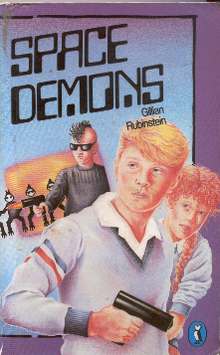
What I was expressing was my deep desire to completely connect with electronic songs like Popcorn, The Never Ending Story, Infinity and whatever was happening on my Strictly Techno 2 cassette. I wanted to trip as hard as I could, powered by my imagination and a box of Nerds. Like in the book Gillian Rubenstein’s Space Demons where the characters are trapped inside a video game, I wanted to be sucked inside these songs – able to fly along the sonic dimension they existed within. I could hear and see music, I wanted to be able to touch, taste and smell it as well. I don’t think many other people my age wanted to smell anything to do with Guru Josh. He had a goatee and always looked sweaty. (I later discovered he fell out of favour after publicly supporting Thatcherism).
My love of arpeggiated synths continues to this day, and I’ve been drawn to it in recent alt-rock tracks such as Grandaddy’s The Crystal Lake, Wilco’s Heavy Metal Drummer and the music of Ratatat. I’ve used it on one of my own songs For The Love I Have For You, to moderate success, but have resisted the urge to buy my own keyboard. I fear that once I find the arpeggiation settings and put on the cans, I’ll swim down a sonic wormhole of no return.
FURTHER LISTENING — A PHOENIX DOUBLE HELIX
The Gorillaz Plastic Beach features an arpeggiator drop so satisfying that the comments reference the 0:41 point of the song!
When you’re sleeping and your body does that fake fall thing
When you’re playing Rock paper scissors in the mirror and you win.
Gorillaz // Plastic Beach
Slow Meadow // Artificial Algorithm
DIG ON THE FULL PLAYLIST…
* Rage Against The Machine made their guitars sound like electronic effects, and each album contained in the liner notes “no samples, keyboards or synthesizers used in the making of this record.”
2009 was the busiest year of my life. I was doing everything. In the space of 12 months I made two albums, wrote and performed a new Comedy Festival show (which encored in Fringe Festival), orchestrated a national album tour, got a gig acting on John Safran’s TV show, wrote monthly columns for Frankie magazine, went in Comedy Festival Roadshow, moved house, broke up and fractured my humerus in a bicycle mishap.
I didn’t necessarily need a time intensive weekly sketch radio show to helm, but the thing was, I’d accidentally-on-purpose landed this dream opportunity to go wild creatively on a respected citywide platform.
I’d been going into Triple R a lot to appear on the spoken word show Aural Text, hosted by poet Alicia Sometimes. Each summer, the tradition was regular hosts took holidays and had a b-team fill in. I agreed to take on a four episode fill-in job for Aural Text, 12-2pm Wednesdays.
I gathered together a hit crew of my favourite alt-comedy pals. We wrote some sketches and ideas. We brought scripts in to perform live. We lined up interviews with local notables such as Marieke Hardy. While our interview skills left a lot to be desired, station manager Mick James was so impressed with our comedy that he had to stick his head in at one point to confirm we were actually busting it live.
“You’re the most organised summer-fill I’ve ever seen,” he said.
It boded well.
By the end of our month, Mick was a fan. He offered us our own regular timeslot. We ended up kicking out the long-running comedy show in the Monday 7pm slot. They weren’t exactly happy about it. They gave us six months. The show ran for five years.
Thrilled with this promotion, we went to town. Writing, recording and home-editing our own sketches. We would leave ourselves room to do a news and reviews segment live in the studio. Add in special comedy guests and maybe one silly song and you had the hour.
Damien Lawlor was the unofficial captain of the good ship weird. His unbridled tenacity single-handedly kept the thing alive. Charlie Brooker grade genius engine of under the skin, on the money, in your face segments including the long-running Hugh Jackman Diaries and hyper-local gems such as Punt Road & Music Snobs Through The Ages.
Josh Earl was his loyal lieutenant. He brought whip-smart pop-cultural satire smarts to add lightness to Damien’s odd nebula. Songsmith laureate Craig Lee Smith made up his own songs about towels & biscuits.
Hats off to Eva Johansen, member of cabaret comedy act Caravan Of Love. I think she is a vocal genius. One of the main reasons I’m kicking off this reel is to share her delightful talents.
Lime Champions! Sketch comedy for men and women. It was a lot of work. It was a lot of fun. It was on when people were getting tea ready. I’ve been carrying around a CD of my favourite originals. I think they’re okay.
The lady in front of me was resting her head on some yarn. A good tip for first time travellers! Captured on a gorgeous day on Tasmania’s own Redline Coaches. It marks the final episode of my radio series The Heart Of The Bollocks. I recorded the secret life of buses for Triple J’s Morning Show.
My playful docu-radio series from 2003 has been unearthed from the vaults. I’m not a has been, I just had early success at a time before social media, so a lot of my output aired once and never surfaced again. Can you imagine? Appointment radio. You’re either listening at 10:30 AM on a Wednesday or you’re toast as far as being an early adopter of visionary pioneer rapscallion Justin Heazlewood’s unique take on the vibe goes.
In 2003 I was keen to follow up my songwriting segment on Triple J’s Morning Show. There was a new team onboard and they didn’t have a lot of budget. I ended up doing a bit of work experience. I’d just moved to Sydney for a girl and was finding it all a tad overawing. To break the ice with my new city I felt like running around with a DAT recorder and using the authority of being ‘Justin from Triple J’ to create some casual, whimsical vignettes.
The Heart of the Bollocks features my original music and poetry – honed from regular appearances at Tug Dumbly’s alternative poetry night Bardfly’s at the Friend In Hand pub in Glebe. One of the punters there heard my segment and said he liked how it just washes over you.
Here is it, twenty years later – still sounding fresh i guess.
There were four in all. I will post a new one each week under this link so watch this space and subscribe to my channel, buster.
Happy banking.
Produced by Justin Heazlewood in Sydney, 2003. Hosted by Steve Cannane. Commissioned by Kyla Slaven. Cover photo by Tammy Winter.
Banks! contains a sample of Benito Di Fonzo’s poem “I’m frightened, and I want my money.” Streets! contains a lyrical sample from “Feather In Your Cap” by Beck.
Do you have anxiety? If so, I’m sorry to hear that.
So dew eye, for what it’s worth. 👀
[Refer to the mockmarket of the soul and current value of a shitcoin]
2023 – could it be the year of beating anxiety? I’d say ‘war on anxiety’ but that doesn’t sound much fun (or a change). Pillow fight with mental health? Slightly sexy. Passive aggressive standoff with your other half?
Hot.
My point is, Moby has just dropped an ambient album. (Do you ‘drop’ ambient albums or release them as one might release a mist?) He says it’s about helping tackle his anxiety. A donation to the cosmos. Cool. I dig it.
Anxiety, for the record, isn’t just a general state of feeling worried or uptight. It’s a physical thing. Like being softly electrocuted. A black magic chain of thoughts that hijacks your thinking, making you act irrationally. It lives under the skin, like an alien. An agitated immersion in a strange, stricken brew. A cauldron of caution. A maelstrom of malady.
Ambient music is a perfect antidote. It’s slow, for starters. Anxiety travels at the speed of unsound. It doesn’t help that the pace of the world has been increasing (along with the temperature) for the past thirty years. In 1990 we had grunge music with a bpm in double figures. Folks now listen to podcasts at double speed. Cramming data isn’t precisely what consciousness evolved for.
Set your position to pause. Mood quake serenade.
Ambient music (also known as new age) may be an acquired taste. It might not be your cup of herbal tea. ☕
Ambient is spacious. It doesn’t have beats or lyrics, much. It’s a space, man. It doesn’t ask much from your mind. You can slip on your life cancelling headphones and soak in the sound. Let your thoughts play host to singular, spaced notes. Slow honey for a blow up head.
It’s a gentle suggestion. I’m a fan of Brian Eno and Harold Budd and Radiohead. The latter had a crack at ambient with ‘Treefingers’ from Kid A. It was pretty (chime) ballsy of them. That album was popular. This is probably my first ever experience with ambient music. YouTube comments suggest ‘Treefingers’ is “the one everyone skips.” Honestly, I would be included in that. Young men are not famous for their patience – but it wouldn’t surprise me if it made a comeback. The world is much more electronic instrumental savvy than it was in 2000.
Don’t worry if you don’t know where to start (or end). The beauty of Spotify is you only need one song to connect with and then select the radio for that song. That’s all I’ve been doing for five years really – unboxing a pandora’s pantheon of timestretched permusations.
Stockpiling chillout I can access in the fraction of a migraine. 🧠
Heck, sometimes technology works in favour of mental health. Maybe this is the only time. Perhaps you find success with meditation apps? Personally I can’t stand someone lecturing me. Having said that, Lemon Jelly do have a song called ‘Nervous Tension’ which is basically a self-help tape set to music.
From my new years meanderings I see there’s a recently released The Art Of Meditation by Sigur Ros. Electronic dude Jon Hopkins put out a Meditations single in 2020 & Music For Psychedelic Therapy in 2021 (the latter is a bit rich for my blood). Meanwhile, my good friend Conrad Greenleaf released the ambient album Dreamtape last year – so it’s in the zeitgeist, surely.
There’s even Tasmanian based ambient artists such as Leven Canyon & All India Radio.
Chillout was huge in 2000, so it might be experiencing a twenty year ambiversary.
If you’re fond of sand dunes and salty air
Quaint little villages here and there
Groove Armada – At The River
There are other strategies to combat anxiety:
A sleep routine.
Talking to a psychologist.
Lying in a dark space with a weighted blanket.
Repetitive movements such as playing an instrument, walking, swimming or massage.
It’s worth trying everything. Make it your hobby – discovering pockets of air within your dark cloud. 🫧
Unrest is the best that life can offer, sometimes.
Make the most of finding a way to live with it.
The
brain
is
a
funny
alien.
Welcome
to
the
animal
that
chose
you.
Half the fun is remembering how to train it.
Finding the time to take it for walks.
Perhaps ambient music acts as a holodeck, allowing you to return to a home planet green and purple and blue and grey – where the days stretch out like dreams and the atmosphere is so gentle you find it easier to float.
You don’t have to meditate to listen to ambient music. You don’t need ambient music to meditate. Both are notoriously niche and slippery to appreciate. I file them under exercises for exhausted people. Or, there are 200k worse things you can do on your phone.
Take care in there.
Justin, 2023. *
please see my little playlist elbow, I mean below.
“Just take those old records off the shelf. I sit and listen to them by myself.”
Old time rock ‘n’ roll by Bob Segar. It’s a song about being by yourself. Solitude. This poor bloke, just wanting to listen to his nostalgic music collection. It’s uncanny that this song is one of my standout memories from primary school. As juniors we would sit in a circle as our music teacher put it on.
“Now, just listen to it as an example of recorded music. What can you hear?”
Some funky low-end. That breakbeat drop out bit. A curmudgeonly old rocker that seems to have stayed the same age as I caught up. Thirty years later and I’d be the one taking old records (and old CDs) off the shelf. I’d also be in fair agreement that today’s music ‘ain’t got the same soul’ – caught in the double-bind that simply admitting that is some kind of cultural own goal – basically advertising your own irrelevance to the younger, hipper generations. But then, who needs words to do that when I have my colourless hair?
(Bob Seger is considered the godfather of belligerence. He was the first Boomer to slag off the generation after him, a sentiment now carried in alarming numbers across every second youtube comment on any song released before 1980. Is it fitting that the music he’s dissing is probably the very early 80s soft-rock that I now commandeer?)
There aren’t enough cool, tough songs that casually mention being by yourself. (“Maybe he’s born with it….maybe it’s Radiohead.”) 90% of songs are about love and 90% of those are propaganda for couples, basically saying ‘being alone is the price you pay for fucking up love. So… love…don’t fuck it up!’
I remember feeling haunted by music in the wake of my relationship strike in 2009. Music became a surveillance ghost as tunes trailed me onto the bus.
“I can’t live if living is without you.”
“I know I’ll never find another you.”
“How am I supposed to live without you?”
I fought back with my first purchase of over-ear headphones and a predilection towards ambient electronic music. Boards of Canada, Four Tet, early Caribou – they had no words. I didn’t have any songwriters’ agenda being pushed onto me – like a liquified diary spray-painted on my garden wall.
Now, I’m sort of enamoured by mid 80s ballads that so brazenly and eloquently declare a stoically melancholic mood.
“Look at me standing / here on my own again / up straight in the sunshine No need to run and hide, it’s a wonderful, wonderful life No need to laugh or cry, it’s a wonderful, wonderful life.”
Black, Wonderful Life (1987)
From the inappropriately boppy cover by Ace Of Base at my high school social*, to truly comforting black velvet cloud of nostalgia and ambience in my ballads playlist – this song has had a journey. I love that it’s by an artist known simply as Black.
* no wait, I’m thinking of the Ace Of Base song Beautiful Life – but then they did do a cover of Wonderful Life but not until 2002, when I heard it somewhere other than a high school social – you’d hope.
As a member of the solitude community, I deeply respect its acknowledgement of the simple truth that human life can be played out in relationship exile, through no particular design or fault of anyone. It’s a slight change from the default whitewash of families and couples that the large proportion of recorded advertising media is concerned with.
It has been suggested recently that there is still an obvious bias against single people. For example, theatre tickets are usually sold as pairs and sometimes single seats can’t be bought towards the end. (See: victory for spinster theatregoers)
Single people are assumed in deficit.
I’ve often thought, if you are by yourself and your main impression of this position is a sense of being incomplete, then how problematic is that?
All of humanity’s problems stem from man’s inability to sit quietly in a room alone.
French philosopher Blaise Pascal (in the 1600s)
When there’s nothing to lose and there’s nothing to prove Well, I’m dancing with myself
British philosopher Billy Idol (in the 1980s)
‘All By Myself’ ruined Christmas. It’s such a crass take on the quiet, moving, wryly sophisticated juxtaposition of ‘Wonderful Life.’ Lately I’ve thought that Cat Stevens’ ‘Another Saturday Night’ also does justice. It humanises the lonely characters’ plight.
Another Saturday night and I ain’t got nobody I got some money ’cause i just got paid How I wish I had someone to talk to I’m in an awful way.
SAM COOKE, another saturday night (1964)
As an aside, I don’t think I ever knew this was a cover.
A hit that was largely background to me now plays as a doom-pop appraisal of a sometimes weekly predicament. For most of my 20s and early 30s, Sunday afternoons were the hardest part of the week to trawl through. Something changed in my mid 30s. As I began to make peace with my childhood blues, I realised that a social deadzone for making plans with pals was Saturday night. And so, a sense of foreboding and pressure built up, so that each Saturday afternoon felt like a mini New Year’s Eve without the parties or fireworks.
It was as if I had a weekly reminder that I was single. ‘Just think Justin,’ the cruel checklist insisted, ‘all those lovely young things out there on dates, together. All those long-term couples, meeting up with the other couples. And you, buddy, here, in this room, by yourself – as proof you exist.’
Ah, but see, I was never alone. How can I be truly lonely when I have music? Music is magic. Straight up.
It’s a message in a bottle full of oxygen I can dream.
And if music outstays its welcome then there’s always some kind of movie. And if that isn’t what the doctor ordered then surely beer rounds everyone up and wraps them in a team huddle and gives them enough of a pep talk to convince all the moving parts of the generous, loving, hope-drenched, melancholic_ambient person to crack on and forget about the flim-flam of the dickheads outside, that yabbering on is overrated and we have all the low-lighting and controlled-volume environment we could ever want right here.
It’s a wonderful, wonderful life with old time rock ‘n’ roll.
JJ Cale, he’s my man. The guy isn’t even alive anymore. What’s the point of meeting anyone, if I can’t even tell him how in awe I am of his music?
Related reading: i is the loneliest letter (2022)
Thanks: Will Hindmarsh for suggesting 'Dancing With Myself.'
This is an album I made when I was eighteen and my nickname was Phonze! I’ve reimagined / remixed it with never released tracks and field recordings from the era.
Kurt Cobain, Shane Warne, stoners and skaters – girlfriends and god references – it’s a rough and tumble time capsule from the late 90s by a dude right into Beck and Radiohead exploring his own internal cosmos while honouring friends and Volkswagens with whatever means necessary. Brought to you by Sony Walkmans, Washburn guitars & Windows 95.
I first heard Aimee Mann’s I’m With Stupid in grade ten. The year was 1996, the town: Burnie; the shop: Soundwaves Record Bar. I had just started my first job as a death-cook for KFC, earning my own money – albeit $4.70 an hour. I think two hours of slave labour may have covered the heavily discounted double fluro price tags on this particular Cee-Dee. (One cannot underestimate the victory of actually finding something you liked on special, given that the average album price was $31.50 – today’s equivalent of paying for six months of Spotify to hear the same ten Pearl Jam songs, one of them skipping.)
I’d only just gotten my first CD player, characteristically late to the go-go-gadget party. While other kids were playing NBA Jam on Mega Drive I had a second-hand Amstrad green screen with Bombjack loading on tape. On our modest pensioner budget I was the Piping Hot polar fleece to my best friend Billy’s Billabong jacket. Musically enforcing my insider/outsider status; while other boys were ensconced in Gunners and Green Day – I was investing in techno cassingles like Here’s Johnny and/or discounted quirky songstresses from LA.
Another plot-point in the meeting of the Mann’s was that it was only the previous year that the North-West coast of Tasmania had started receiving Triple J. (Pair this with the fact Burnie got MacDonalds in 1993 and you can begin to appreciate the colossal injection of excitement for a teenager in the back-sticks. If Tassie had scored its own AFL team maybe I’d’ve gotten the cultural trifecta.) Triple J had upgraded my stereo to that of ham radio. Via its social subscription I was a two-way team member of my generation, doors opening to reveal Jane Gazzo pied-pipering us through a bandwidth banner as my imagination ran onto the hallowed mainland astroturf of alternative anthems by King Missile, Faith No More and Cake. Romantically, I was single, yet my relationship with this cool cosmos community was a fascinating defacto funfest.
(I rang Calamity Jane up a few times, determined to tell her how I was going to break the school’s 50m freestyle record, that my nickname was Phonze and could she please play ‘Bentley’s gonna sort you out.’)
Justin (FRONT) probably only giving the thumbs up to air off some recent third-degree burn from the chicken vats or industrial ovens
Meanwhile, ‘Long Shot’ by Aimee Mann was on medium rotation. I can confirm this as I have a tape of it being back announced by Michael Tunn (admonishing the previous caller for ringing up from their mobile phone while on a domestic flight. “They say you shouldn’t ever do that”). There’s also an interview with Gibby from Butthole Surfers and a segment where callers phone in with the flaws they’d spotted in Independence Day. The whole thing couldn’t be more 1996 if Fran Drescher was covering Lump by Presidents sponsored by Stussy.
If anyone asks you if there’s a newfound nostalgia for CDs – the format we long swore we’d never feel anything but bemused, obligated indifference towards once the shiny holographic promise of their ‘unbreakable’ marketing gave way to the snake-oil-charlatan reality of two years wear resulting in every second song getting a remix by Fatboy Slim – backed with the retina-stretching liability of deciphering liner notes in 7-pt; the answer is a resounding, mid-life, bellowed into a pillow: “yes.”
Yes, I played Long Shot, nay, BLARED IT in Surround Sound™ which my Sharp 3 CD changer afforded me, noting the spatial clarity compared to the head-under-the-bed compression of the Taped Off The Radio sound. Oh, to be sixteen again, plonked on the edge of your single mattress, pouring over the dynamic fridge magnet artwork and hazy artist portraits (all lyrics from I’m With Stupid are broken down into individual words and listed alphabetically)!
Hormones coursed through my gangly system like a technicolour forest of beauty and woe – crystallising my mood inside the lonesome wilderness of adolescence. Sparkly, intimate signals emanated from the padded black grills of the speaker box – entertainment as art absorbed in a halo of intelligence, curiosity and satisfaction. Beneath the alternative ambience of an after-school afternoon I afforded myself a double-value victory lap as my mechanical friend lurched the album around its carriage and back to the loading position. Helped by the odour of a Peter Jackson Super Mild smuggled out the window. I was revived and thriving, anything but alone in my teenage control room.
I was pleased to have a new inclusion in my modest CD collection, (comprising of RATM’s Evil Empire, Guru Josh’s Infinity, Spacehog’s Resident Alien, Butthole Surfer’s ‘Pepper’ single and Bruce Springsteen’s ‘Streets of Philadelphia’.) Aimee was my first musical girl. I knew nothing about her at all. I didn’t mind in the slightest. I was her prince silly, rescuing her from the discount bin in a small town that for multiple reasons hadn’t connected with her blend of Alternative pop-rock and whimsical lyrics about heartbreak and selfless relationships with damaged people – a theme it would take me another few years to fathom and two decades to perfect.
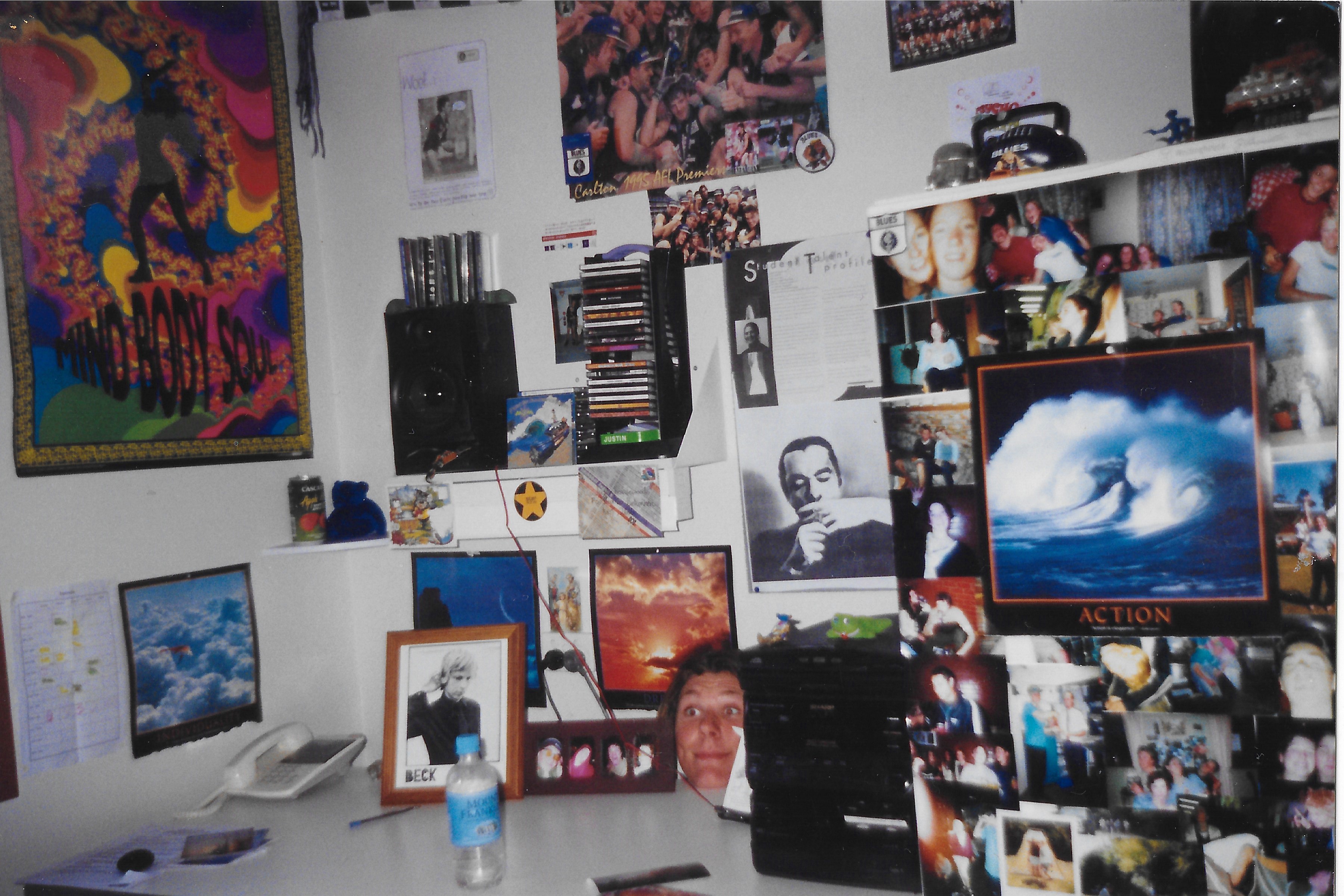
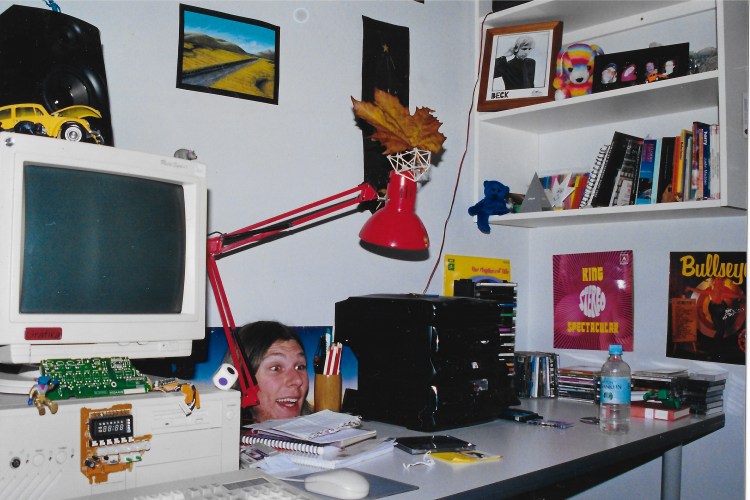
Justin’s very decked out room on residence at University of Canberra, 1999. You can make out the Sharp 3 CD changer and CD collection. I don’t know about you but I can also clock the timeless spines of Pearl Jam’s No Code, Beck’s Mellow Gold and George’s Holiday EP – err how did that get in there. Fair dues Holiday by George always has me tearing up. Is that tearing up, as in the healthy emotional response or tearing up as in tearing up my paper mache chain mail as I walk slowly backwards through IKEA? Much like what the chap says at the end of Radiohead’s Just, it’s best we never know.
In my first year at University in Canberra, my emotional world was blossoming outwards and inwards, not dissimilar to the flower motif depicted in Magnolia. Paul Thomas Anderson’s masterwork was a timely injection of Aimee Mann wonderment which sent the cultural value of I’m With Stupid climbing the rungs of my CD tower ahead of recent hotshots Garbage, Ben Folds Five and my failed experiment with Counting Crows. Released in 1999, Magnolia was the first real arthouse film to connect with my generation (that wasn’t Romeo & Juliet or Young Einstein.) Indeed, it was so good that it was actually hurting my new best friend Matt, literally depressed that he’d never make anything that good in his lifetime.
Aimee Mann’s song ‘Deathly’ single-handedly inspired the entire movie. If there’s a higher honour that has been paid a songwriter in recent times I’d be interested to hear about it. In the liner notes to the soundtrack Paul Thomas Anderson writes: “She is the great articulator of the biggest things we think about: ‘How can anyone love me?’ ‘Why the hell would anyone love me?’ and the old favourite ‘Why would I love anyone when all it means is torture?’”
It would make sense that a director would be drawn to Mann’s songs as they play like lyrical storyboards. There is a sense of narrative, of place. The language is visual and immediate. As PTA goes on to say “Aimee is a brilliant writer” and these are ‘story songs’ – which is perhaps a quality that could be dismissed as being a little, dare I say it, daggy. By that I mean to say that Aimee Mann’s compositions are disarmingly, wholesomely forthright when compared to contemporaries such as PJ Harvey or Tori Amos – fuelled by an edgier riot-grrl poetic abstraction.
That isn’t to say Aimee’s lyrics or compositions aren’t edgy. Any cabaret-esque over-spelling is under-written with smarm, juxtaposition and wit. S**t yes, Aimee Mann is witty! A rare quality in female artists that don’t toe-dip in pseudo-novelty such as Jill Sobule’s ‘I Kissed a Girl’ or Diana Anaid’s ‘I Go Off.’ Aimee’s an off-kilter, off-broadway eccentric, like Rufus Wainright or Suzanne Vega – or, more closely to my discographic heart; fellow LA misfit troubadour Eels.
Eels is also a bit ‘daggy’ in the indie-cool scheme of things, (Well, maybe I’m speaking out of school and drawing too much attention to my own internal crisis of confidence about what is relevant – but Pitchfork have slagged off most of his releases for being musically two-bit and lyrically hokey, which is code for ‘the kids aren’t comfortable with artists, (especially men) wearing their mentally ill minds on their sleeve and being intentionally vulnerable unless it’s done ‘authentically’ by a mentally unstable artist such as Daniel Johnston. Read: ‘If you’re going to be troubled, either strip it right back by singing your breakdown on a warbly acoustic, or, have the courtesy to dress naked lyrical honesty with full-tilt production al la Nine Inch Nails – self-pity is way too unpalatable to be presented as musically laid-back and self-aware as Eels does. Anyway, I disagress. (Disagreeing with my own digression.))
And, didn’t rage play Eels surprise new single only last week? (Oh good he’s going back to his Souljacker days.)
Pitchfork gave Aimee Mann’s complicated 2000 album (which she released independently after record labels were bamboozled by its lack of singles – who is she taking career advice from, Fiona Apple?) 9/10, so what would I know. Answer: heaps. Buy me a milo.
I’m told the case is now closed So I can come to my senses But when the question is posed I’ll have this meagre defence
Aimee’s songs are riddled with metaphor. Everything’s a set up. Love as a heist, relationships as a court case, boyfriend as a fallen superhero. There are twists on words. Plays on devices. Ducking and weaving and jabbing and hooking – Mann is the lyrical shadow boxer – floating like a butterfly tattoo and stinging like a worker bee.
As Paul Thomas Anderson pontificates: “She writes lines that are so simple and direct, you are convinced that you have either A) heard it before B) said it before, or even C) thought of it before (and just never wrote it down).”
I was hoping you’d know better / I was hoping but you’re an amateur
Songs are mostly about breakups. Odes to the calamity men who’ve wooed and screwed her every which way to dinnertime. I read that she had battled depression – there is a defiant dramatic tension that offsets any long stays on glib island.
I’m a superball / If you bounce me once I’ll ricochet / Around the room
So row, row, row your boat gently down the stream / I hope you drown and never come back
Anger marinated in eccentricity basted with irony. This recipe sets Mann apart from her contemporaries such as Sheryl Crow or Alanis “irony” Morissette. The lyrics are immediate, conversational and visual. Mouthfeel of the mind with heart aftertaste. They never drift or waft, rather announce and elucidate stakes of the highest order from a dulcet energy palate.
I’m so relentless / And you’re defenceless
Oh, and she rhymes her socks off. 🧦 Ms Mann’s like Dr Seuss meets Karen Carpenter.
You may wonder what the catch is / As we batten down the hatches
A double syllable rhyme worthy of Kim Carnes’ precocious / pro-blush.
But of course, the central thread that carries me from creation to memory and back is the voice. Aimee Mann owns my devotion through the gorgeous timbers of that velvet chamber.
And I don’t even know you / I don’t even know you anymore
She can hit the high-notes that fall you to the floor. She can glean the low-tone that floats your nose to the ozone. She whispers friendly and dangerous – truths disarmed in confident softness. Mann has approximately the best voice in history. Like none other in the canon. A god-standard Chrissie Hynde / Harry Nilsson masterclass in originality.
Hers is the vocal equivalent of a fresh pressed ruby velvet jacket. Sinking deep into a shady orange corduroy lounge, sipping an expensive bottle of French-Canadian merlot, reaching for a soft pack of Stuyvesants.
An Aimee Mann album feels like a special occasion. No, I don’t listen to her regularly. (Perhaps the richness of her voice means that one becomes fuller, sooner.)
But when I return I am always uplifted, reminded, surprised.
I’m With Stupid was one of the last holdouts on Spotify – outlasting Bill Callahan and Beyonce. (Mysterious, as the rest of her catalogue was there.) I lost my original CD and recently purchased a new second-hand copy, for approximately the same amount I paid in ’96 – in some satisfying twist of capitalist consistency. I was mesmerised by how much more alive the songs sounded. My ears used more muscles; heard extra instruments. As my friend Conrad once said “CDs sound better than streaming, even burnt ones. It’s something about the preamps in stereos.”
That said, in my current station; no longer the new sensation and far from the legacy veteran, it would not be in my best interests to bore you with rhetorical implorations to go out and buy your first CD in like, 15 years. All I’ll say ROCK FANS, is that there’s never been a better time to revisit this obscure slice of mid 90s Alternative and find a comforting voice in these abrasive times.
Dig?
I saw Aimee play live in 2009. I’d heard she was notoriously shy and awkward, especially about banter between songs. So much so that she’d hired a comedian to act as MC at her US concerts. Over-compensating for this by a long-shot – she proceeded to jabber nervously for up to ten minutes while taking photos of the audience before playing a single note. I am churlishly in awe of my idols when it becomes obvious they are consistent in their vulnerability.
At the end of the set she was taking requests. I was too insular to yell but I would have requested Long Shot. It is still one of my favourite songs of the nineties – conspicuously absent from any themed playlist.
Whatever.
A. Mann
And the award for best swearing in the opening line of an album:
You fucked it up / You jumped the gun / I swore you off / but You climbed back on.
Aimee Mann does this bright/melancholy, sweet hook, minor chord-twist dark pop thing that just fucking kills me. In a good way. It’s weirdly too rare in rock music. Any band that can do this as good as Aimee Mann, you’ll make me emotionally crumble and feel like life’s beauty is indisputable. Adam Gropman (via youtube)
Aimee Mann – I’m With Stupid (1995, Geffen)
Key tracks – Superball, Long Shot, Sugarcoated, Choice In The Matter.
Fun Fact: Aimee dipped her toe into acting by playing one of the German nihilists in The Big Lebowski. (Continuing her love affair with indie-darling directors).
Gigs: Aimee is touring Australia in 2021/22 with appropriate folk oddball Ben Lee!
Know something I don’t?
Keep it to yourself.
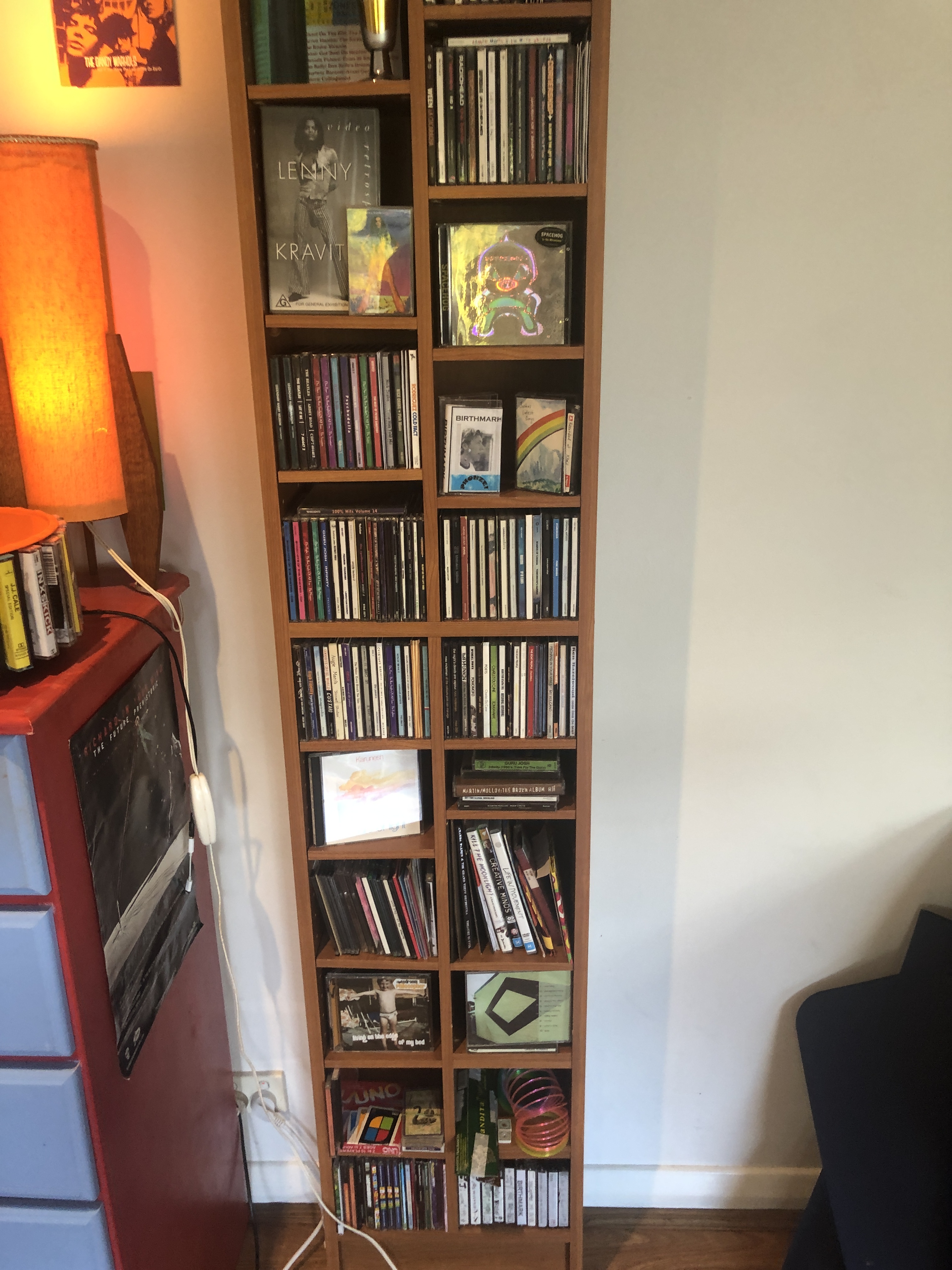
Justin’s CD inventory as catalogued by then girlfriend Tammy at their sharehouse ‘The TAJ’ (named after occupants Tammy, Adam and Justin) in Totterdell Street, Canberra, 2001.
A very 2001 looking, CD orientated sharehouse wall. Note the square metal CD holder display which I bought from a mail order catalogue in grade 12. BTW that is the Beatles poster I mention in Megan the Vegan. (CD display features Waikiki, Skunkhour, Supergrass, New Buffalo, Sleepy Jackson, Dandy Warhols, Divine Comedy, a fairly rare single from Radiohead’s Amnesiac and Starsailor!)
I guess you could say I have an intimate knowledge of indie releases from 2001 because of my job at the Uni magazine Curio. We were getting sent lots of review CDs and it kept me across awesome female singer-songwriter sneaker singles such as Airport ’99 by Phillippa Nihill of Underground Lovers and Like A Feather by Nikka Costa (one of Mark Ronson’s first hits as producer). Not to mention a promo copy of Aimee’s Bachelor No. 2 or, the Last Remains of the Dodo – now THAT’S how you title an album.
T H E E E N D E
READER SERVING SUGGESTION
Justin, hello, it’s reader here. I enjoyed your column about Aimee Mann.
Thanks!
You write in a very original, thoughtful manner. I remember my first CD by a female that I bought in my country town and there’s a great story about it. Shall I share it with you?
Please.
Where can I read more of your writing like this, in this style or whatever.
Oh, there’s the “MUSIC” tab under ‘Columns’ which has a few similar proto-pretentious fine-arts deep-drives. Or just keep scrolling down the page as I’ve recently gone on about the film Love Serenade and my love of synthesisers.
Okay, thanks Justin, I really appreciate you sharing your writing here on your website.
Thanks! I appreciate the feedback, even though there is no comments field because WWPD (what would Pitchfork do)?